The Sushi Chef Knows Where to Cut
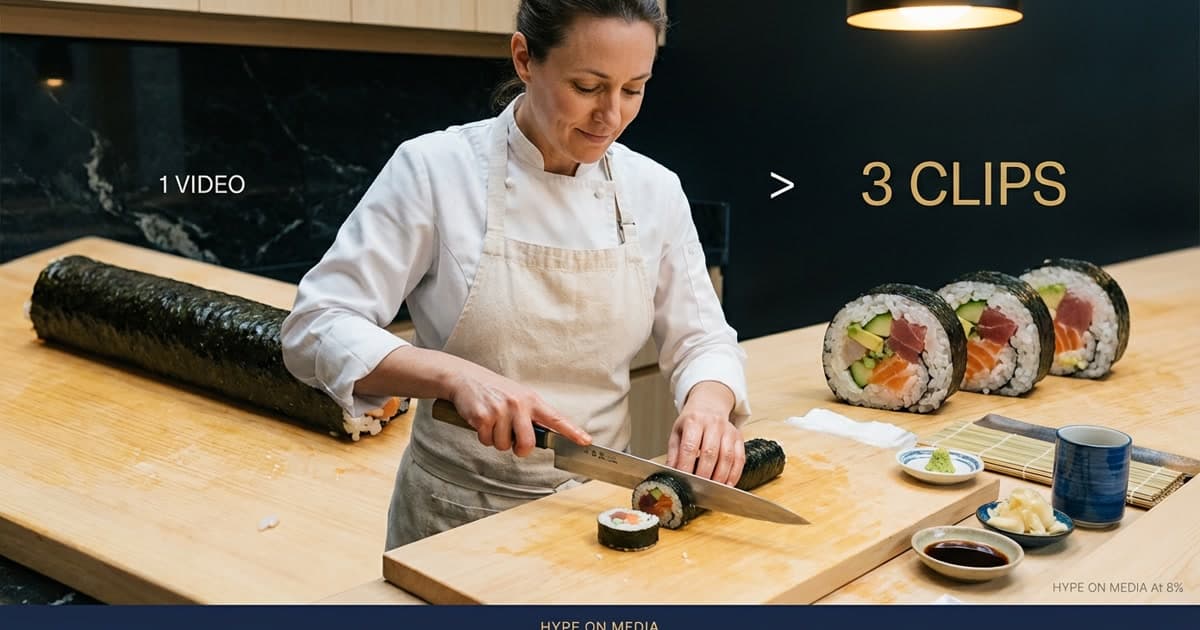
Watch a sushi chef work. She takes one long, carefully constructed roll — rice, fish, vegetables layered with precision over five minutes of assembly — and with three clean cuts, transforms it into individual pieces that each stand on their own. Every piece has the same quality as the whole roll. Every piece is self-contained. The chef did not make seven different dishes. She made one, and cut it intelligently.
That is the YouTube-to-LinkedIn repurposing framework. YouTube is where you make the roll — 10-15 minutes of depth, research, expertise. LinkedIn is where you serve individual pieces — 60-90 second clips that each deliver a complete insight. You do not create separate content for each platform. You produce once with depth on YouTube, then cut with precision for LinkedIn. LinkedIn video posts generate 3x more engagement than text — and the content is already made. It just needs the right cuts.
Across our B2B client portfolio, channels that implemented this workflow saw LinkedIn video views increase an average of 340% in the first quarter — without increasing production budgets.
Why YouTube Is the Right Kitchen
YouTube and LinkedIn serve fundamentally different viewer intents, but they are not incompatible. YouTube viewers arrive with search intent or exploratory behavior. LinkedIn viewers scroll a professional feed looking for ideas, insights, and industry perspective. Long-form YouTube content that explores a topic in depth is exactly the source material that produces high-value LinkedIn clips.
The production quality gap favors YouTube-first production. A 4K YouTube master file looks exceptional in the LinkedIn feed. But more importantly, the depth of thinking required for a 10-15 minute tutorial generates quotable, shareable insights that work on LinkedIn.
The workflow logic: YouTube is where you develop thinking at length. LinkedIn is where you distribute the most compelling distillations to a professional audience who will not watch 12 minutes but will absolutely watch 90 seconds.
What translates from YouTube to LinkedIn:
- Counterintuitive insights delivered as standalone claims
- Step-by-step frameworks compressed into 60-90 second walkthroughs
- Expert opinions stated confidently with supporting evidence
- Behind-the-scenes process breakdowns demonstrating expertise
- Data-backed predictions about industry trends
What does not translate:
- Intro/outro sequences with YouTube branding
- Mid-video deep dives requiring prior context
- Long-form storytelling dependent on 5+ minutes of pacing
- Clickbait titles requiring an 8-minute resolution
Where to Cut: The Hype On Repurposing Workflow
Our production workflow identifies LinkedIn clips during the edit phase — not as an afterthought after upload.
Stage 1: Pre-production clip mapping
During scripting, we tag moments that are LinkedIn extraction candidates:
- The single most counterintuitive claim in the video
- The "what most people get wrong about X" segment
- Any step-by-step process that stands alone in 90 seconds
- The strongest data point with immediate practical implication
This tagging happens in the script document, not in post-production. By the time we edit, LinkedIn clips are already identified.
Stage 2: The LinkedIn-format edit
LinkedIn clips require different editing than YouTube Shorts or TikTok. The professional audience responds to measured pace and cleaner presentation.
Our format standard:
- Duration: 60-120 seconds (120 is the ceiling)
- Aspect ratio: 1:1 (square) — outperforms 9:16 and 16:9 in LinkedIn feed based on our testing
- Captions: Always on, large font, high contrast — 85% of LinkedIn video plays without sound
- Intro: Lead with the insight, not preamble ("Here's why your B2B content isn't converting" not "Hey everyone, today I want to...")
- Branded lower-third with speaker name, title, company — LinkedIn audiences value professional identification
Stage 3: LinkedIn-specific CTA
YouTube CTAs are meaningless on LinkedIn. CTAs that drive engagement:
- "Follow for weekly [topic] insights" (drives follower growth)
- "What's been your experience with this?" (drives comments — LinkedIn comments are weighted heavily in its algorithm)
- "Full breakdown at the link in comments" (use sparingly — LinkedIn limits reach on posts with external links)
Stage 4: Distribution timing
LinkedIn content performs best Tuesday through Thursday, 7-9am and 12-1pm local time. Stagger LinkedIn publication 3-7 days after YouTube upload — this prevents the clip from cannibalizing the YouTube video's early performance window.
Writing the Caption That Makes the Video Worth Watching
The caption is not a description of the video — it is a standalone text post that makes the video worth clicking play. LinkedIn's algorithm surfaces posts in text form before a viewer decides to play. If the caption does not earn attention independently, the video will not be watched.
The formula:
Line 1: The most provocative claim from the video. No context. No "in this video." Just the claim.
Lines 2-4: Supporting context with one specific number or named framework.
Line 5: One question or invitation that creates a reason to comment.
Line 6: "Full breakdown: watch above" or "[video title] — 90 second version above."
Example:
"Most B2B YouTube channels optimize for views. They should optimize for leads.
We analyzed 23 channels in financial services. The ones with the highest lead conversion had 60% lower view counts than the top-viewed channels.
Topic selection and CTA architecture matter more than algorithm performance.
What metric is your B2B channel actually optimizing for?
Full breakdown: watch above."
The Compounding Effect: LinkedIn Feeds Back Into YouTube
The strategic value is not just immediate distribution. It is the data feedback loop between platforms.
LinkedIn engagement patterns reveal which content angles resonate with professional audiences. A clip generating 200 comments on LinkedIn tells you something specific about the anxiety, debate, or curiosity active in your industry right now. That signal feeds back into YouTube content planning — informing which topics to develop into full-length videos.
We predicted in early 2025 that B2B brands would shift to treating YouTube as the production hub and LinkedIn as the primary distribution channel for professional audiences. By Q3 2025, our B2B clients were generating more qualified leads via LinkedIn video than via YouTube direct traffic — even though YouTube remained the production and SEO foundation.
The two platforms work together. YouTube builds content depth and search discoverability. LinkedIn builds professional audience and shortens the consideration cycle. Starting from YouTube is the right logic because it forces the depth of thinking that makes LinkedIn content genuinely valuable — not just visually formatted for the feed.
Frequently Asked Questions
How long should YouTube-to-LinkedIn repurposed clips be? Based on our data, 60-90 seconds is optimal. Under 45 seconds lacks context to drive comments. Over 2 minutes sees significant completion drop-off. LinkedIn's algorithm weights completion rate heavily.
Should I post LinkedIn clips before or after the YouTube video? Post 3-7 days after the YouTube upload. This gives the YouTube video its full early-window performance before the LinkedIn clip surfaces to overlapping audience.
Does cross-posting hurt either platform's algorithm? No. LinkedIn does not detect YouTube upload dates. YouTube does not factor LinkedIn activity. The risk is audience perception — if follower overlap is high, slightly different clip selections for each platform mitigate repetition fatigue.
What aspect ratio works best for LinkedIn video? Our testing: 1:1 (square) consistently outperforms 9:16 vertical and 16:9 landscape. Square takes up more feed real estate on mobile without the full-screen interruption of vertical.
How many LinkedIn clips can I extract from a single YouTube video? For a 10-15 minute video, we extract 2-3 clips. More than 3 from a single source feels repetitive. Each clip must be independently valuable — not a sequential series.