The Best Lake Had One Fisherman
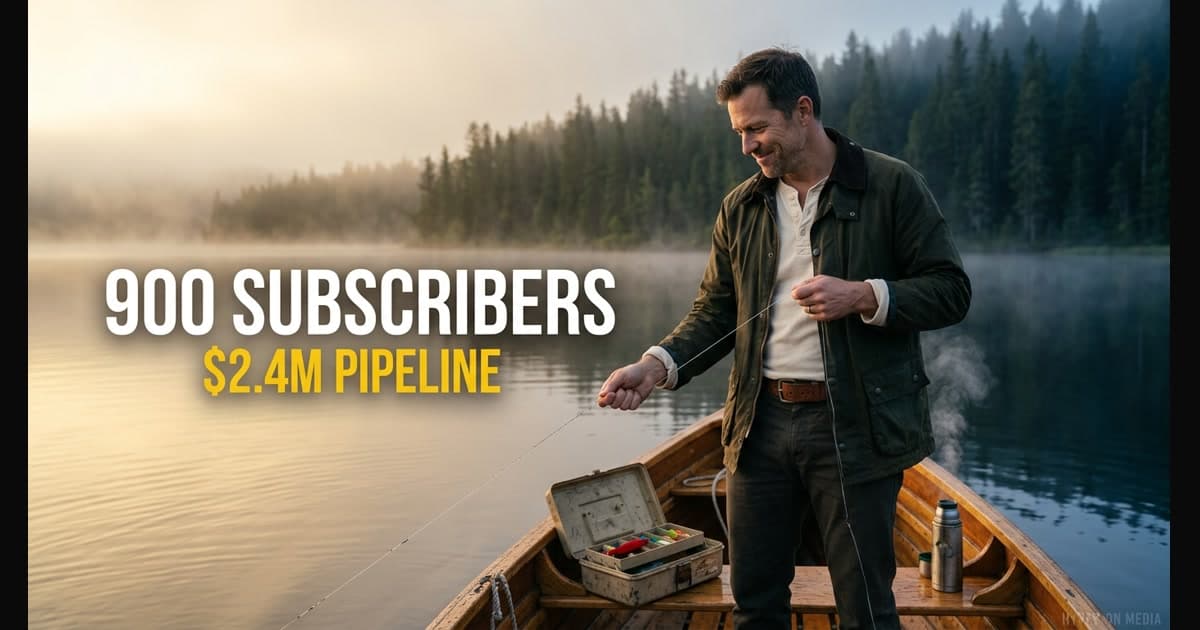
Imagine a lake stocked with trophy bass — the kind serious anglers dream about. Crystal-clear water, perfect depth, no restrictions. And nobody is fishing there. Not because the fish aren't biting, but because everyone assumed the good spots were somewhere else.
That is B2B YouTube right now. While your competitors crowd LinkedIn with the same thought leadership posts, the richest fishing grounds in digital marketing sit almost empty. The buyers you want are already there — watching product walkthroughs, architecture deep-dives, and vendor comparison breakdowns. They are doing their homework before they ever contact you.
The fisherman who shows up catches everything. Not because he is the best fisherman, but because he is the only one casting.
This article is the system that makes that advantage real — and the data behind why every quarter you wait hands more fish to whoever shows up first.
The 30-Minute Research Window You Are Invisible In
B2B buyers are not impulse shoppers. According to Google's own B2B buyer behavior research, nearly half of B2B researchers watch 30 or more minutes of video during their research process — and almost one in five watch over an hour. That research primarily happens on YouTube.
This is not consumer behavior leaking into business. A VP of Marketing evaluating analytics platforms watches product walkthroughs. A CTO comparing infrastructure providers watches architecture deep-dives. A procurement director watches case study breakdowns to validate vendor claims before the first call. The research happens on YouTube whether you are there or not. The only variable is whether buyers find your content or your competitor's.
Google's B2B research confirms that 70% of B2B buyers and researchers watch videos throughout their path to purchase. And that path starts long before anyone visits your website — CEB and Google research puts B2B buyers at 57 to 70% of their decision-making complete before they ever engage a vendor. By the time someone fills out your demo form, they have already formed a shortlist. Your YouTube presence determines whether you are on it.
In our experience managing 50+ B2B and branded YouTube channels, the pattern is consistent: the brand that shows up in that research window gets the demo request. The brand that doesn't gets compared unfavorably — or never enters the consideration set at all.
Five Objections That Sound Reasonable and Cost a Fortune
Every B2B team that delays YouTube gives the same five reasons. Every one of them has a structural answer — and a real cost for waiting.
"I can't prove ROI on content." The CFO doesn't care about views. They want to know what closed. Standard attribution models miss YouTube entirely because the bulk of buyer decision-making happens before any vendor touchpoint — what researchers call the dark funnel. The fix is a four-step attribution pipeline: UTM-tagged description links, CRM flags on video-exposed prospects, self-reported attribution at the demo stage, and pipeline velocity comparison between YouTube-exposed and non-exposed prospects. The goal is not perfect attribution — it is directional data strong enough to justify continued investment. Start there.
"We don't have a video team." The B2B channels generating serious pipeline run lean. One subject matter expert records 60 minutes per month. A production partner handles strategy, editing, optimization, and distribution. Output: four to six optimized videos plus 20 to 33 derivative pieces across Shorts, LinkedIn, and newsletters — the content multiplication model Gary Vaynerchuk documented and that production teams have operationalized at scale. The bottleneck is never talent. It is process.
"YouTube feels too slow." LinkedIn shows engagement in 48 hours. YouTube takes months. But what the quarterly-planning crowd misses: 14 videos published in January are still generating demo requests in November — without a single additional dollar spent. Q4 pipeline was built in Q1. The companies that understand this treat YouTube as infrastructure, not campaigns. Infrastructure compounds. Campaigns expire.
"Our audience isn't on YouTube." Pew Research Center's 2025 data shows YouTube reaches 92% of adults aged 30 to 49 and 84% of all U.S. adults. Google's B2B research confirms 70% of B2B buyers watch video throughout the purchase process. Your buyers are on the platform. The question is whether they find you or your competitor.
"We tried it and nothing happened." Channels that "tried YouTube" typically published 8 to 12 videos, saw modest views, and quit. That is like casting a line three times and declaring the lake empty. YouTube creators consistently report needing several months of consistent publishing before the algorithm begins surfacing their content to new audiences — the system needs enough signal to understand who you are and who should find you. Every channel that quit in the first few months quit before the algorithm had enough data to work.
Three Structural Mistakes That Kill B2B Channels
The methodology that works for B2B YouTube is not "make videos and hope." It is a system that connects content directly to pipeline. Most teams fail at three structural things.
They build around thought leadership instead of buyer search intent. "The Future of SaaS" is a thought leadership topic. "Why Usage-Based Pricing Fails for Enterprise SaaS" is a buyer search query. One gets shared at conferences. The other gets watched at 11pm by a VP evaluating vendors. Specificity wins — because it matches the exact query a decision-maker types when they are actively researching. The fish you want are searching for specific bait, not generic lures.
They publish but never repurpose. Ahrefs, which has built one of the most effective B2B YouTube channels in the SaaS space — crossing one million subscribers with product-led educational content — treats each video as a content engine, not a one-off. A single 20-minute video becomes Shorts, LinkedIn clips, blog posts, newsletter features, and social quotes. When one production feeds the entire content pipeline, per-asset cost collapses. This multiplication effect makes YouTube the highest-ROI content investment — not because the videos are cheap, but because everything downstream is nearly free.
They report vanity metrics instead of pipeline signals. The only three numbers that matter for B2B leadership: qualified traffic from YouTube to landing pages (measure with UTM parameters), pipeline velocity for YouTube-exposed prospects (measure with CRM integration), and cost per qualified view. A video with 500 views that drives 12 qualified demos is worth more than one with 50,000 views from an irrelevant audience. The teams winning at B2B YouTube do not report "views" to their CEO. They report pipeline influence.
The Compounding Advantage That Gets More Expensive to Chase
Every video published on YouTube adds to a searchable library that generates pipeline indefinitely. This compounding effect makes YouTube fundamentally different from every other B2B channel — and it is why starting late costs more than most teams realize.
The mechanism is straightforward: a video published today ranks in search results today, tomorrow, and two years from now. It gets recommended by the algorithm to relevant audiences in perpetuity. Compare that to a LinkedIn post that has a 48-hour window before it vanishes from feeds. The math is not even close.
Semrush built significant brand authority and driving product trial directly from YouTube by investing consistently in search-optimized product education — not through viral moments, but through the compounding effect of hundreds of videos targeting specific buyer queries. Their channel became a discovery engine for prospects who had never heard of the brand through any other channel.
The brands that will own YouTube in your category by 2027 are the ones publishing right now. Every quarter deferred is a compounding advantage your competitors are building on your buyers' attention — attention you will have to outspend to reclaim later.
What Is Shifting in 2026
Three forces are reshaping B2B YouTube. The teams building now will capture the most value from all of them.
AI-generated video is flooding the platform with noise. YouTube's algorithm is getting better at distinguishing depth from filler. B2B channels with genuine subject matter expertise — real humans explaining real problems with specific, verifiable detail — will see their relative advantage increase as generic AI content saturates surface-level topics. The empty lake stays fishable longer when the bait that works requires actual expertise to create.
Connected TV is changing where B2B buyers watch. Nielsen's The Gauge (July 2025) shows YouTube captured 13.4% of all TV viewing — ahead of Netflix and every other streaming service. B2B decision-makers are watching product walkthroughs on their living room TV at 9pm. This changes what "good enough" looks like. Channels that treated YouTube as a serious production channel from day one are positioned to take advantage of the biggest screen in the house. Channels that relied on webcam recordings and auto-generated thumbnails are not.
The dark funnel is becoming measurable. YouTube's attribution tools, combined with CRM integrations and self-reported attribution surveys, are giving marketing teams the data they need to prove YouTube ROI in language their CFO accepts. The measurement gap that kept B2B teams away from YouTube is narrowing. According to Wyzowl's 2025 State of Video Marketing report, 85% of video marketers say video has helped generate leads, and 83% say it directly increased sales. The teams already inside will capture the most value as measurement becomes standard.
The System, Not the Channel
Your buyers spend 30 minutes on YouTube before they ever call you. The compounding advantage grows every quarter you wait. This is not a content strategy question. It is a pipeline question.
The answer is a system: revenue-first content architecture built around buyer search intent, a repurposing engine that multiplies one production into 20-plus assets, and attribution infrastructure that connects every video to pipeline signals the CFO can read. The lake is stocked. The competition is light. The only question is whether you show up to fish.
Whether you build that system in-house or work with a team like ours, the framework is the same. The only variable is how fast you move.
Frequently Asked Questions
How long does it take for a B2B YouTube channel to generate measurable pipeline?
Most B2B channels begin seeing measurable pipeline signals — demo requests, self-reported attribution from buyers, UTM-tracked traffic from video descriptions — after three to six months of consistent publishing. The first 90 days are about building library depth and training the algorithm. Attribution infrastructure should be in place from day one so that when the results arrive, you can measure them.
How do you measure YouTube ROI when the impact happens before a sales conversation?
The standard approach is a four-step attribution pipeline: UTM-tagged description links for direct traffic measurement, CRM integration that flags prospects who consumed YouTube content before requesting demos, self-reported attribution surveys at the demo stage ("how did you first learn about us?"), and pipeline velocity comparison between YouTube-exposed and non-exposed prospects. The goal is directional signal, not perfect attribution — the same standard applied to any brand investment.
What does a B2B YouTube operation actually require?
The minimum viable operation requires one subject matter expert willing to record 60 minutes per month — typically answering pre-written questions on camera. Everything else — strategy, scripting, editing, thumbnail design, metadata optimization, distribution, and attribution reporting — can be handled by a dedicated production partner. The key is separating expertise (your people) from production (repeatable process). In our experience, the bottleneck is never talent. It is always process.
Is it too late to start if competitors already have a YouTube presence?
No, but the cost of catching up increases every quarter. A competitor with 12 months and 50 videos has a real head start — but YouTube rewards specificity over volume. Channels have reached category-leading positions in six to nine months by targeting the specific buyer search queries their competitors missed or underserved. The longer the wait, the more ground to cover — but the ground is always coverable.
What does a realistic first 90 days look like?
Month 1: Audit the competitive landscape, identify the 12 highest-value buyer search queries in your category, publish the first four videos optimized for those queries. Month 2: Analyze retention data, test thumbnail variations, launch the repurposing pipeline. Month 3: Connect YouTube analytics to the CRM and deliver the first pipeline influence report. By day 90, there is data — not promises — to justify scaling. That data becomes the CFO conversation.