YouTube Just Repriced Its Own Inventory
May 15, 2024. David Geffen Hall, Lincoln Center. YouTube stood in front of the media buyers, CMOs, and agency leads who collectively decide where billions of ad dollars move — and told them the living room belongs to YouTube now.
Brandcast is the platform's annual NewFronts pitch. It is where YouTube convinces the TV money to move. This year, three announcements did more than pitch — they repriced what premium YouTube inventory is worth.
Creator Takeover ads. AI-optimized non-skippable CTV placements. Branded QR codes on television.
Each one changes something. Together, they mark the clearest inflection point YouTube has given brands in years: the economic distance between average YouTube content and premium YouTube content is about to widen significantly — and the channels that qualify for the premium tier will earn accordingly.
We track Brandcast closely because it determines the economic environment our clients operate in. A channel positioned for Creator Takeover inventory in 2024 takes 12-18 months to build. That work started in 2023.
Creator Takeover: 100% Share of Voice on the Top 1%
Creator Takeover is the most expensive thing you can buy on YouTube. One advertiser. 100% of ad impressions across the top 1% of creator channels. A defined window — typically 24 hours. No competing ads. No category conflicts. No programmatic spillover.
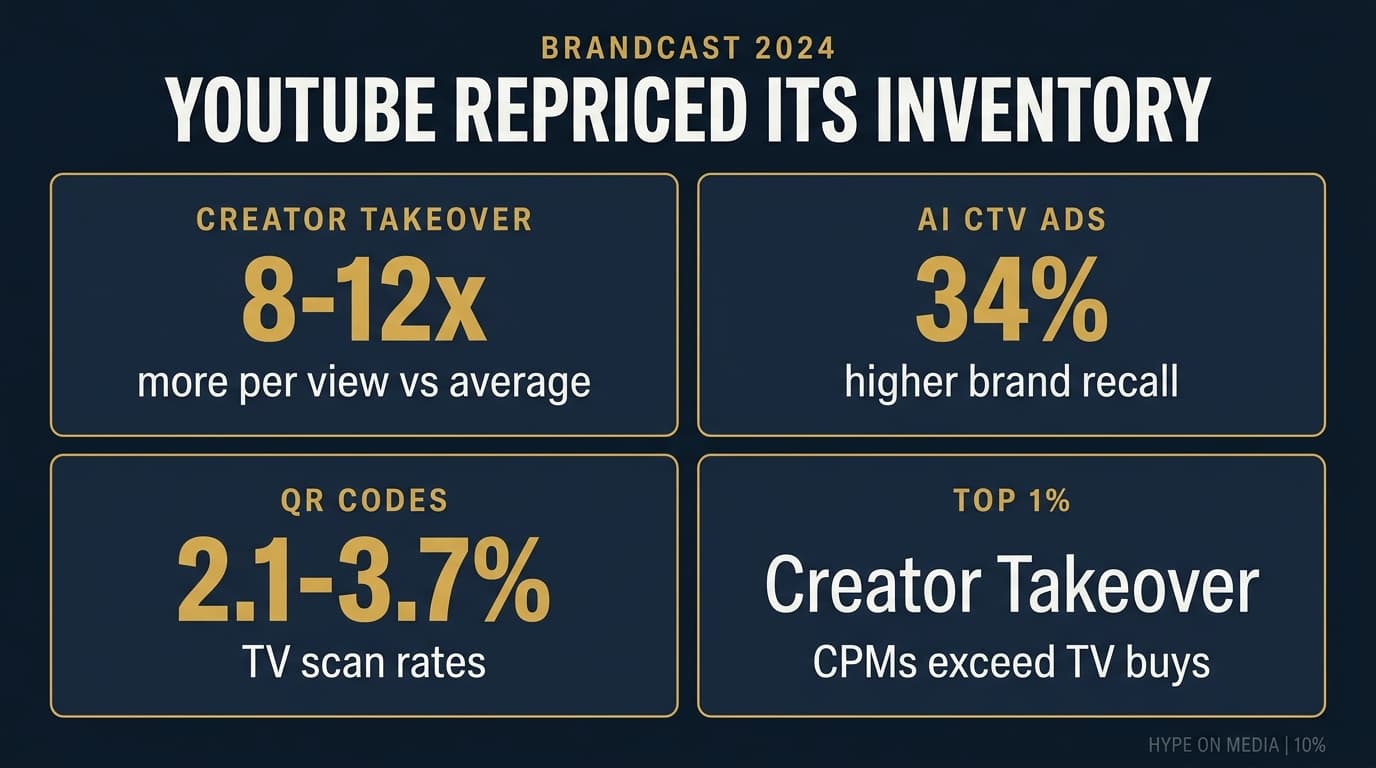
Within six months of the announcement, Creator Takeover CPMs exceeded comparable television buys. That outcome was predictable. Demand for premium, brand-safe, creator-adjacent inventory has outpaced supply since 2022. Creator Takeover formalizes the scarcity and puts a price on it.
For creators, the math is stark. A channel with 500,000 engaged subscribers that consistently qualifies for top-1% inventory can earn 8-12x more per view than a channel with 2,000,000 subscribers that generates weak advertiser confidence signals. Size is not the variable. Quality is.
The signals that determine whether a channel qualifies:
- Content that consistently clears YouTube's advertiser-friendly threshold — no sensitive topics, no grey-area content
- Engagement rate above the category benchmark (returning viewers, not passive ones)
- Verified audience demographics, low spam comment ratio
- Clean monetization record for the trailing 12 months
- Minimum audience size within the top 1% for that content category
The last point matters more than most creators realize. The threshold is relative, not absolute. A smaller channel in a high-value B2B niche can qualify while a large channel in a brand-unsafe category cannot.
For brands on the buying side: Creator Takeover is expensive by digital standards and competitive with premium television when you adjust for targeting precision and viewer attention quality. CTV audiences watching creator content are more engaged than linear TV audiences by every measurable signal available.
AI-Optimized Non-Skippable CTV Ads
The second announcement changes the operational picture for any brand running YouTube CTV campaigns.
Before: ads inserted at fixed intervals — pre-roll, mid-roll at creator-defined timestamps — regardless of where viewer attention actually was.
After: YouTube's AI monitors real-time engagement signals, historical engagement patterns for that content type, and time-of-day attention data. It inserts non-skippable ads at the moments when viewer attention is statistically highest.
The results YouTube shared from internal measurement studies: 34% higher brand recall and 28% higher purchase intent for ads placed at high-attention moments versus fixed-interval placements. For awareness and consideration campaigns, that is a material efficiency gain on the same spend.
The creator-side implication is subtler but compounds over time. YouTube's AI selects content with reliable, predictable attention patterns over content with erratic retention curves. Structured tutorials, strong narrative arcs, deliberate hook sequences — content that generates consistent high-attention moments — becomes more valuable advertising inventory by design.
This is the mechanism behind something we have seen play out across dozens of managed channels: production discipline compounds into monetization outcomes. A client whose videos follow a structured retention architecture — engineered attention peaks, chapter-based pacing — systematically earns higher CPMs than unstructured content at equivalent view counts. Not slightly higher. Meaningfully higher.
The AI optimization layer makes that gap official policy.
Branded QR Codes: TV Attribution Is Finally Solved
The third announcement is the most forward-looking. Branded QR codes for interactive YouTube CTV ads.
A viewer watches on television. A QR code appears during the ad. They pick up their phone and scan it. They land on a product page, offer, or experience. The conversion is tracked.
This closes the attribution gap that has made TV advertising frustrating for performance marketers for decades. Traditional TV ads generate awareness that is genuinely difficult to connect to downstream conversions. YouTube QR codes create a direct, measurable path from the living room to a mobile action.
Impression → scan → product page → tracked conversion.
Pilot campaign data shared at Brandcast: scan rates of 2.1-3.7% across consumer packaged goods, automotive, and financial services. That is meaningfully higher than any previous TV-to-digital bridge mechanism. For brands running YouTube CTV at scale, it transforms the channel from awareness-only to full-funnel.
The categories where QR code TV ads outperform:
- Consumer products with impulse purchase patterns — food, beverages, entertainment subscriptions
- Products requiring research comparison — automotive, electronics, financial products
- Direct-response offers with time sensitivity — sales, limited editions, event registrations
- B2C services with clear signup flows — apps, subscription boxes, online services
One creative consideration: QR code placements perform best on content that attracts engaged, leaned-forward viewers — tutorials, reviews, explainers. The viewer actively watching to learn something scans at higher rates than a passive entertainment viewer. Content intent correlates with ad interaction quality.
What the Brandcast Announcements Actually Mean for Strategy
Read the three announcements together and one message is clear: every layer of YouTube's premium advertising economy is being built to reward quality.
Creator Takeover selects the top 1% of channels. AI optimization rewards high-retention, well-structured content. QR code interactivity rewards engaged, attentive audiences.
The mid-tier still exists — average content, programmatic CPMs, undifferentiated placements. But the economic gap between mid-tier and premium is widening, not narrowing. The brands and channels positioned in the premium tier will earn an increasing share of the premium ad budget.
For brands currently investing in YouTube: the priority is ensuring your content strategy qualifies for the premium tier on both sides of the transaction — as an advertiser placing against premium inventory and as a channel that generates premium inventory. Different investment, shared compounding effect.
For brands not yet on YouTube: Brandcast 2024 gives you a pricing signal. The premium end of YouTube advertising is pricing in at television rates. The channels that will capture that premium in 2025 are being built in 2024. Every quarter deferred is market share and algorithm equity that competitors are accumulating.
Creator-Brand Integration: The $400M Upfront Signal
Brandcast 2024 did not just announce new ad formats — it repositioned creator-integrated content as a distinct, premium advertising category.
Creator-integrated content, where the brand appears authentically within the creator's narrative rather than as an interruption between segments, outperformed traditional pre-roll and mid-roll across every brand metric in YouTube's 2024 Brand Impact studies. The numbers: 4.8x higher purchase intent and 3.2x higher brand favorability versus equivalent non-integrated placements.
The market response was immediate. Several major brands committed to creator-integrated campaigns during the Brandcast upfront season. Total creator partnership commitments exceeded $400 million for the 2024-2025 cycle. This is no longer a "digital experimentation" budget line. It is a primary media investment.
When the brand is part of the story — not an interruption to it — both the creator and the advertiser benefit. The audience trusts the creator. The creator's credibility transfers to the brand. The brand gets something television cannot deliver: a trusted human voice, speaking directly to a self-selected audience.
The brands that understand this dynamic are buying ahead of it. The ones that do not are still comparing CPMs.
Frequently Asked Questions
What is YouTube Brandcast and when does it happen?
YouTube Brandcast is an annual advertising industry event — part of the NewFronts digital media upfront season — where YouTube presents its advertising products, audience data, and creator partnerships to brand advertisers and agency media buyers. It typically takes place in May in New York. The 2024 event was held May 15 at David Geffen Hall, Lincoln Center, and featured announcements on Creator Takeover ads, AI-optimized CTV placements, and branded QR codes.
What is a Creator Takeover ad on YouTube?
Creator Takeover is a premium YouTube ad product that gives a single advertiser 100% share of voice — every ad impression — across the top 1% of YouTube creator channels during a defined period, typically 24 hours. It eliminates competing ads and category conflicts, delivering exclusive brand presence in the most-watched creator content. Pricing exceeds traditional television CPMs for comparable demographic targeting.
How does AI-optimized CTV advertising on YouTube work?
YouTube's AI optimization system identifies high-attention viewing moments within CTV content based on real-time engagement signals, historical patterns, and time-of-day attention data, then inserts non-skippable ads at those moments. This improves brand recall by 34% and purchase intent by 28% compared to fixed-interval ad placements, according to YouTube's internal measurement studies.
What channels qualify for premium YouTube ad inventory?
Channels qualifying for Creator Takeover and other premium placements maintain consistent advertiser-friendly content ratings, above-benchmark engagement rates, high returning viewer percentages, verified audience demographics, and no monetization policy violations in the trailing 12 months. The top-1% threshold is benchmarked within content categories — a smaller channel in a high-value niche can qualify while a larger channel in a brand-unsafe category cannot.
Should smaller brands consider YouTube advertising after Brandcast 2024?
Yes. The Brandcast announcements introduce premium tiers at the top end but do not eliminate mid-market options. The QR code and AI optimization features are available across all non-skippable CTV placements, not just Creator Takeover inventory. Smaller advertisers benefit from improved attribution and attention optimization regardless of budget size. The strategic case for YouTube advertising strengthened across all budget levels in May 2024.