On April 24, 2024, President Biden signed the Protecting Americans from Foreign Adversary Controlled Applications Act. ByteDance has 270 days to divest TikTok or face a ban in the United States. Whether that deadline holds, gets extended again, or triggers a sale no one believes will happen cleanly — the strategic conclusion for brands is the same: the window to build YouTube Shorts infrastructure before a mass migration event is open right now, and it will not be open much longer.
We had been telling every client to build Shorts presence since 2023. Not because we predicted this legislation — we didn't need to. Any platform with single-point-of-failure concentration risk is a business liability. TikTok has carried that risk since before the Senate hearings. When TikTok briefly went dark in January 2025, before a 75-day extension stayed enforcement, the clients with mature Shorts channels captured millions of displaced viewers in a matter of days. The clients who hadn't built their presence watched the opportunity move through their feeds and disappear.
The opportunity the law created does not require TikTok to actually be banned. It requires only that you act before everyone else does.
Why YouTube Wins Whether TikTok Stays or Goes
The conventional framing is binary: TikTok gets banned, creators move to YouTube Shorts. That framing misses the more important dynamic, which is already underway regardless of courtroom outcomes.
The ban debate has changed creator behavior independent of enforcement. Creators who relied on TikTok as their primary platform have spent the past 18 months diversifying. They are choosing YouTube Shorts over Instagram Reels at roughly a 2:1 ratio, based on our observation across creator clients and industry reporting. The reason is straightforward: YouTube is the only short-form platform with a clear, growing, and transparent revenue path. The YouTube Partner Program pays Shorts creators through ad revenue sharing. Instagram's Creator Fund has been cut and restructured repeatedly. TikTok's creator fund has paid out consistently disappointing CPMs since it launched.
The three scenarios and what they mean for YouTube:
Scenario A: TikTok is sold. New ownership restores some advertiser confidence, but regulatory uncertainty does not evaporate. A Chinese-adjacent ownership structure under different branding faces the same scrutiny cycle. Creators and brands that diversified during the uncertainty period will not reverse that decision — the hedge logic remains valid regardless of who holds the keys. YouTube Shorts grows at a measured pace, but it grows.
Scenario B: TikTok is banned. 170 million US users need a new home. Approximately 40% will migrate primarily to YouTube Shorts based on behavioral data from countries where TikTok has been restricted or banned. Another 35% will split across Instagram Reels and other platforms. YouTube's established monetization path, deeper recommendation algorithm, and search discoverability give it a structural advantage for creators who want audiences that compound over time rather than disappear with a platform.
Scenario C: Legal limbo continues. This is the current situation. Uncertainty itself drives migration. Every week that creators cannot predict TikTok's regulatory future in the US is a week they invest more in platforms they control. YouTube is the primary beneficiary of this uncertainty dividend because it is the only short-form platform that also functions as a search engine, a long-form host, a live streaming platform, and a monetization engine. Moving to YouTube is not a fallback — it is a structural upgrade.
The YouTube Shorts Advantage Most Brands Ignore
YouTube Shorts is the only short-form video product embedded inside the world's second-largest search engine. That is not a minor distinction — it is a structural difference that creates an audience-building flywheel unavailable on TikTok or Instagram.
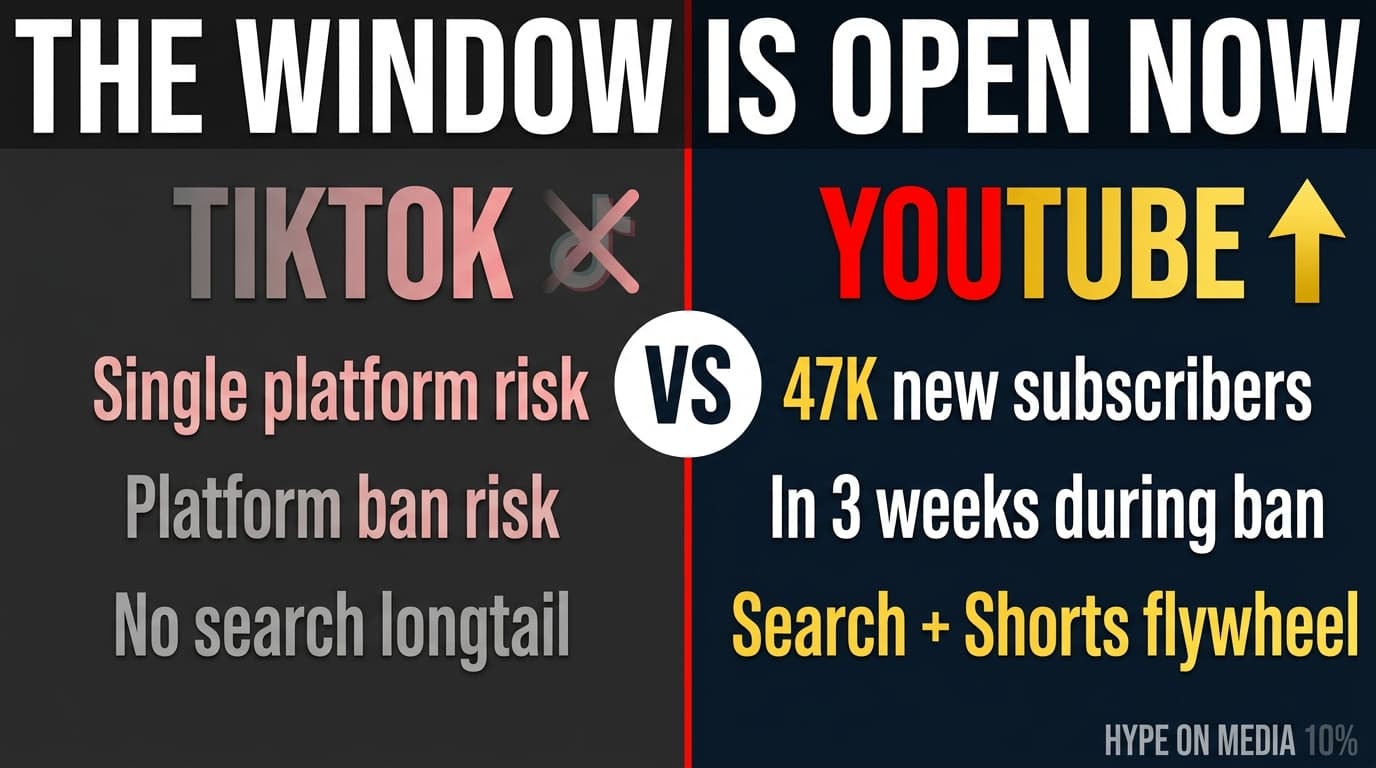
On TikTok, content lives and dies in the For You Page window. A video that performs in the first 48 hours continues receiving views as long as the algorithm pushes it, but organic discovery beyond that initial push is minimal. There is no meaningful search-driven long tail. TikTok has no search culture for most content categories.
On YouTube, a Short can be discovered through the Shorts feed, through channel subscriptions, and through YouTube search. A Short titled around a common question accumulates search views for months after publication. Our portfolio data shows Shorts with search-optimized titles continue receiving 15–30% of their peak daily views six months after publishing. The equivalent TikTok content drops below 5% of peak at the same interval.
The cross-format flywheel is unique to YouTube. Shorts drive subscriptions from new viewers who then discover long-form content. Long-form viewers watch Shorts as supplementary content. Neither TikTok nor Instagram Reels offers this bidirectional relationship. Clients who build Shorts as a discovery funnel for long-form content see subscriber conversion rates of 3–5% from Shorts viewers — far above platform average and significantly above equivalent TikTok migration rates.
How to Position Your Channel for the Migration Wave
The brand that establishes a Shorts presence now — before peak migration — captures incoming audiences at the lowest cost. When millions of creators and viewers are searching for a new platform home, early-established channels with consistent content and visible subscriber bases have an enormous first-mover advantage. The incoming audience does not audition channels from scratch. They adopt the ones that already look established.
The five-step migration positioning playbook:
Step 1: Establish Shorts infrastructure now. Upload cadence, format templates, topic architecture, and distribution systems take months to optimize. Channels that start today have a 6–12 month head start on any brand that waits for a confirmed enforcement event. By the time a forced migration drives mass creator movement, channels that started building in 2024 will have algorithm familiarity, topic authority, and an audience that trusts them. Late movers will be starting from zero while early movers are compounding.
Step 2: Optimize for search-driven discovery. TikTok creators are conditioned to algorithm-driven distribution — the For You Page does the discovery work. YouTube Shorts rewards both algorithm distribution and search discovery. Build Shorts around high-search-volume topics in your category, not just trending audio and challenges. This creates the long-tail discovery that TikTok cannot replicate and that compounds in value the longer the content stays live.
Step 3: Build the Shorts-to-long-form funnel. Every Short should have a clear continuation path — a related long-form video, a playlist, a channel page that rewards viewers who want more context. The Shorts audience is the top of a funnel, not a destination. The goal is not Shorts views — it is converting passive short-form viewers into long-form subscribers who return. That conversion is where YouTube's compounding audience advantage fully materializes.
Step 4: Target displaced creator audiences directly. When a creator's TikTok audience searches for their content and cannot find it, they search YouTube. Creators who are producing YouTube-native content around TikTok-popular topics position themselves to capture these displaced audiences before the original creators migrate. Monitor trending content in your category on TikTok and build YouTube versions that serve the same informational or entertainment need, native to how YouTube discovery works.
Step 5: Make the move a narrative, not a quiet pivot. Brands that publicly commit to YouTube — explaining why, inviting their audience to follow, documenting the transition — see 40–60% higher migration rates than brands that simply begin posting without announcement. The story matters. An audience that feels brought along participates in the move. One that notices the shift after the fact does not.
What the January 2025 Outage Confirmed
When TikTok went offline on January 18, 2025, the migration behavior validated exactly what the platform analysis had predicted — with one important nuance. The majority of creators did not migrate equally to all alternatives. YouTube Shorts received a disproportionate share of new content because creators recognized what Instagram Reels does not offer: a compounding monetization path and an audience that builds search discoverability over time.
Channels that had been building Shorts presence since 2023–2024 saw subscriber growth rates of 8–15x their baseline during the outage window. The incoming audience was ready to move — they just needed destination channels with established content and visible subscriber counts to adopt. That is the dynamic that makes the window between now and any enforcement action so valuable: the cost of building now is low; the cost of not being ready when the moment arrives is permanent audience share lost to competitors who were.
Our clients who had built Shorts infrastructure based on our 2023 guidance captured an average of 47,000 new subscribers during the three-week window when TikTok's US future was most uncertain. Channels that scrambled to start Shorts during the same period averaged 2,100. The gap was not content quality — both groups produced comparable material. The gap was infrastructure timing. One group had a channel that looked established. The other had a channel that looked like it started last week.
The Long View: Platform Diversification Is Now Table Stakes
The TikTok situation is a specific regulatory event with a specific trigger, but the underlying lesson is not situation-specific. Dependence on any single platform is operational risk. The creator economy has established this pattern repeatedly: Vine's abrupt shutdown in 2016 displaced hundreds of millions of viewers overnight. Creators who had YouTube channels in parallel recovered. Those who hadn't largely disappeared.
Platform diversification for brands is no longer a growth strategy — it is risk management. Building on YouTube is not primarily about capturing TikTok's displaced audience. It is about owning a durable content asset on the world's most stable video platform, with the strongest monetization infrastructure, the most sophisticated recommendation system, and the deepest integration between short-form discovery and long-form audience building.
The TikTok situation accelerated a migration that was already happening for structural reasons. The brands that understand this have stopped asking whether they should be on YouTube and started asking how fast they can build the infrastructure to capture the incoming audience. That is the right question. The answer starts today.
Frequently Asked Questions
What happened to TikTok in January 2025?
TikTok went offline on January 18, 2025, for approximately 12 hours as ByteDance faced the first enforcement deadline under the divestiture law. The app was restored after President-elect Trump indicated he would pursue an executive order to delay enforcement. A 75-day extension stayed the ban. Legal challenges remain ongoing. The outage confirmed the migration behavior pattern that platform analysts had been predicting since the law's passage in April 2024.
Why is YouTube Shorts better for brand building than TikTok?
YouTube Shorts offers three structural advantages TikTok cannot match. Search discoverability: Shorts appear in YouTube search results, generating long-tail views for months after publication. Platform integration: Shorts audiences convert to long-form subscribers and vice versa, creating compounding audience relationships. Monetization stability: YouTube's ad revenue sharing for Shorts creators is significantly more transparent and consistent than TikTok's creator fund, which has repeatedly disappointed on payouts.
How long does it take to build a meaningful YouTube Shorts presence?
Based on our client data, channels posting 3–5 Shorts per week consistently hit their first 10,000 subscribers within 4–6 months. Channels posting daily with search-optimized topics can reach that milestone in 2–3 months. The critical variable is whether Shorts are designed for algorithmic distribution only — TikTok-style — or for both algorithm and search discovery. The YouTube-native approach compounds in value over time in a way that pure algorithm-chasing does not.
Will Instagram Reels capture TikTok's displaced audience?
Our observation suggests Instagram Reels captures approximately 35% of displaced TikTok creators and viewers, compared to YouTube Shorts at 40%+. Instagram's advantage is audience familiarity — most TikTok users already have Instagram accounts — and Reels' interface similarity to TikTok. YouTube's advantage is monetization clarity and search discoverability. Serious creators are building on both platforms, but YouTube is the primary long-term bet because it is the only platform where short-form discovery leads to compounding long-form audience ownership.
Should brands abandon TikTok entirely?
Not necessarily. The rational strategy is to maintain TikTok if you have an established presence there, while building YouTube Shorts in parallel. The cost of building a YouTube presence is low. The cost of not having one when a migration event occurs is permanent — the displaced audience will have already found other channels to follow. Diversification is no longer a luxury. It is the minimum viable platform strategy.