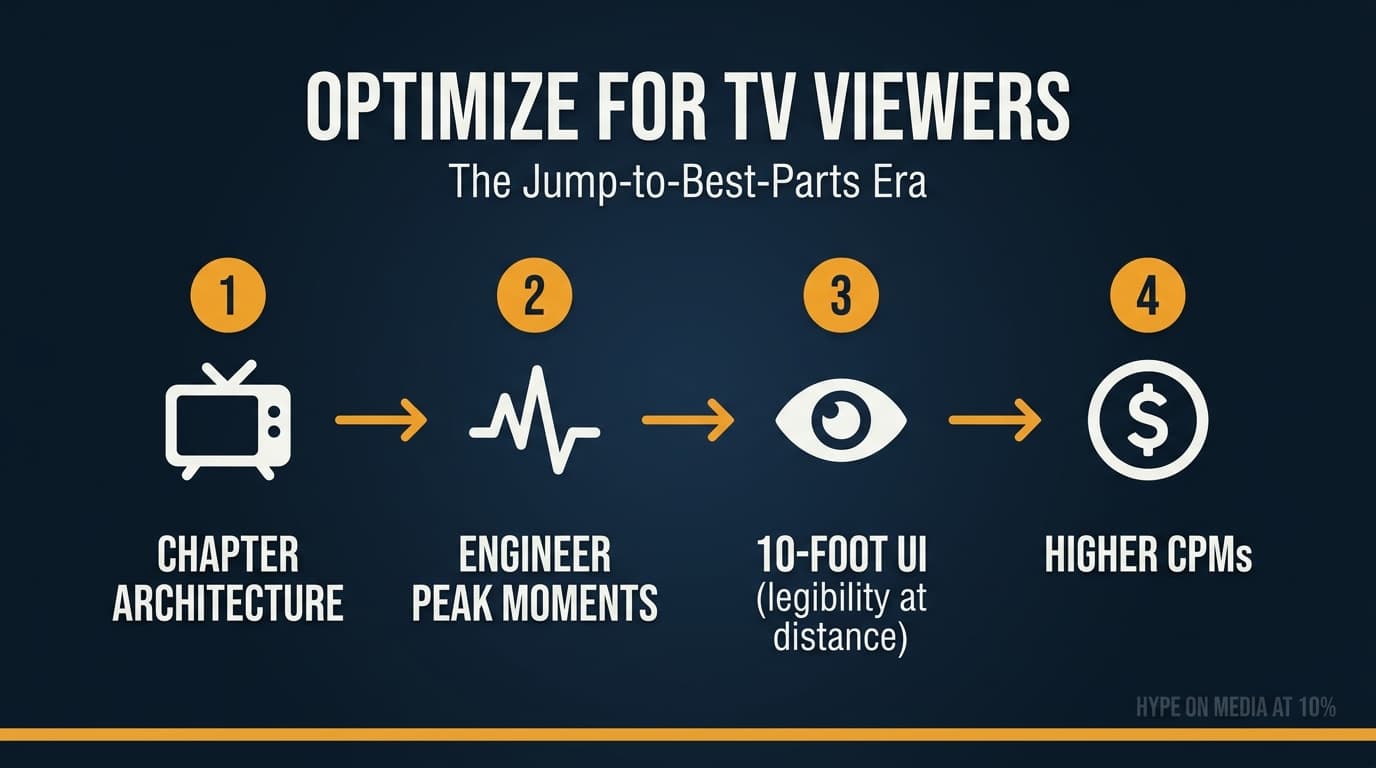
YouTube gave TV viewers the ability to skip to your best moments in April 2024. The channels that had already engineered those moments gained an advantage overnight. The ones that hadn't started losing TV watch time without knowing why.
The jump-to-best-parts feature converts YouTube's existing engagement heatmap — the one that has always lived under the scrub bar on desktop — into an active navigation system on television. Viewers see your highest-engagement segments highlighted. One click and they are there. For a creator who has deliberately built content around strong peaks, this is a distribution multiplier. For one who hasn't, it is an acceleration of abandonment.
We had been structuring client videos around engagement peaks before the TV feature existed, because the underlying signal — rewatch rate per segment — was already influencing recommendations. The April 2024 feature made that signal visible to viewers. The logic was already working. Now the audience can act on it directly.
What "Jump to Best Parts" Actually Does
The feature works by aggregating viewer engagement data across everyone who has watched your video. Segments where viewers pause, rewind, or watch repeatedly register as high-engagement moments. YouTube surfaces those moments as labeled, navigable chapters on the television interface — giving viewers a shortcut to the parts that historically generated the most reaction.
The underlying signals YouTube uses to identify best parts are not equally weighted. Rewatch rate is the most important. A segment that a meaningful percentage of viewers replay signals genuine value — the kind that makes people stop and go back. Forward-skip rate identifies the inverse: moments where viewers consistently jump past indicate content the algorithm should not surface as a highlight.
The four engagement signals that determine best parts:
- Rewatch rate per segment — the primary signal, strongest indicator of genuine value
- Forward-skip frequency — high skips flag weak content, suppresses the segment
- Pause frequency — viewers stopping to absorb information or take notes
- Completion rate from that point forward — does the segment hold the audience through the rest of the video?
For creators, the practical implication is this: if you have never deliberately designed moments intended to generate rewatch or pause behavior, your "best parts" are determined by accident. The segments YouTube highlights for TV viewers reflect whatever organically performed — which may or may not represent your video's actual value.
Structuring Chapters for Maximum TV Impact
Chapters are the infrastructure that makes TV optimization possible. Without them, the jump-to-best-parts feature has no structure to organize around, and the auto-generated chapters YouTube produces are consistently inferior to creator-defined ones — they misidentify topic boundaries, use generic names, and fragment content at the wrong moments.
YouTube requires timestamps starting at 0:00 followed by at least three additional markers. The chapter names that appear in the TV interface are navigable labels — viewers select them by name. "The Secret" generates a fraction of the navigation clicks of "How We Doubled CTR in 30 Days." The specificity of the name signals the value of the segment before the viewer watches it.
The chapter architecture we use for 10-15 minute videos:
For long-form content, five acts define the structure: Hook (0:00–1:00), Setup and Context (1:00–3:00), Core Insight 1 (3:00–6:00), Core Insight 2 (6:00–9:00), Synthesis and Action (9:00+). Each chapter name is written as a benefit or outcome — not a topic label. The viewer reads chapter names before clicking. A name like "Why Most Channels Plateau" creates tension that a name like "Channel Growth Discussion" does not.
Chapter density by video length:
- Under 10 minutes: 3–4 chapters. Too many fragments the content and dilutes per-chapter engagement data.
- 10–20 minutes: 5–7 chapters. Natural act breaks at roughly 3-minute intervals.
- 20–40 minutes: 7–10 chapters. Higher density works for tutorial and educational content where viewers navigate to specific segments.
- 40+ minutes: 10+ chapters, but the better question is whether the content should be a series instead.
The spacing between chapters is as important as the naming. Chapters under 90 seconds rarely accumulate enough engagement data for YouTube to generate a reliable best-parts signal. The algorithm needs minimum dwell time in a segment before it can identify that segment as a peak. Short chapters starve the system of the data it needs to work.
Visual Production for the 10-Foot Interface
Television introduces production constraints that most creators have never addressed. The dominant mental model — optimize for the phone screen — produces content that actively fails on a 55-inch display viewed from across the room. The design paradigm for television interfaces is called the 10-foot UI: everything must be legible, distinguishable, and navigable from ten feet away without requiring the viewer to move closer.
Text legibility at distance. On-screen text — lower thirds, b-roll labels, graphic callouts, stat overlays — must be legible from 10 feet on a standard living-room television. The minimum functional size is 72pt at 1080p for body text, 96pt or larger for primary information graphics. Text that looks clean and appropriately sized on a phone or laptop shrinks into illegibility on a TV at viewing distance. If you would not be comfortable reading it from across a room, it does not belong on screen.
Contrast and compositional clarity. High-detail backgrounds that add visual interest on desktop compress into noise on TV at distance. Clean, high-contrast compositions — where the subject is clearly differentiated from the background — perform better in the CTV context. In our production planning, we apply a minimum 4:1 contrast ratio between primary visual subjects and their backgrounds.
Safe zone compliance. Television displays apply overscan — cutting off the outer 5–10% of the frame depending on the set and its settings. Action-safe zones, the inner 90% of the frame, must contain every piece of critical information. Titles, lower thirds, and graphic elements placed near frame edges are routinely cut off on consumer TVs. Every element that matters must live inside the safe zone.
Cut frequency and pacing. Mobile content has trained creators toward rapid editing — cuts faster than one per second in high-engagement segments are common. On a large TV screen at relaxed viewing distance, this pacing becomes physically exhausting. TV-optimized content uses longer average take lengths, typically 3–5 seconds per cut in standard segments. The energy does not disappear — it shifts to better writing, stronger reactions, and more deliberate visual choices rather than pace alone.
The Engagement Peak Engineering Framework
The opportunity the jump-to-best-parts era creates is not passive — it is not about hoping that good moments emerge and get rewarded. It is about engineering specific moments, in pre-production, to generate the engagement signals YouTube uses to identify peaks. The difference between a channel that benefits from the feature and one that doesn't is whether those moments were designed or left to chance.
At Hype On, we identify three to five moments per video, during scripting, that are explicitly intended to generate rewatch and pause behavior. These are not random — they follow predictable patterns. Each of the five types below maps to a distinct engagement mechanism.
The Revelation Moment. A fact, insight, or statistic that directly contradicts the viewer's existing assumption. "Most channels think CTR is about the thumbnail. It's not — it's about the first three seconds after the click." The contradiction triggers a processing pause. Viewers stop, re-listen, and often replay to confirm what they heard. High pause and rewatch rates follow.
The Demonstration. Showing a process or result in real time. Screen recordings, side-by-side comparisons, before-and-after sequences. Viewers pause to examine details that flash past, or rewind to catch a step they missed. The demonstration must deliver visible evidence that fulfills the video's promise — showing the result, not describing it.
The Framework Presentation. A named, numbered, or visually structured system. "The four signals YouTube uses to decide whether to recommend your video." Viewers want to capture the elements. They screenshot, rewind, or pause to take notes. Frame-worthy information — the kind that makes someone reach for their phone to write something down — generates the strongest rewatch signals of any content type.
The Controversy or Challenge. A direct challenge to a commonly held belief creates a decision point: accept or reject the claim. Either response drives active engagement with the content that follows. The viewer leans in.
The Practical Payoff. A step-by-step implementation sequence. Viewers pause to follow along, rewind when they miss a step, and complete the segment at high rates because they are executing, not just watching. For instructional content, this is almost always the highest-engagement segment in the video.
Why TV Viewership Data Should Change Your Strategy
Videos that perform well on TV generate longer watch sessions, higher completion rates, and better viewer satisfaction scores than the same content watched on mobile. Television is a lean-back, high-attention context. Viewers have made a deliberate choice to sit down and watch — they are not scrolling through a feed or multitasking. The viewing session is intentional in a way that mobile rarely is.
YouTube's data shows TV viewers generate 1.4x more watch time per session than mobile viewers. They also generate 2.1x more ad revenue per view because connected TV ad rates are substantially higher than mobile CPMs. A channel with 30% of its viewership on TV earns measurably more than its total view count implies. The mix matters as much as the volume.
Our data across CTV-optimized client channels shows videos with strategic chapter architecture see 18% longer average view duration on TV screens compared to videos without chapters. The structure itself is a signal of quality. TV viewers use chapters actively — not only as navigation tools, but as indicators that the creator understood how their audience watches. A well-chaptered video communicates deliberateness. An unchaptered one communicates the opposite.
By the end of 2024, CTV viewership was approaching 35% of total YouTube watch time. Channels that structured their production for the television context in 2024 are building compounding advantages in the format where audience attention is most concentrated and most valuable.
Frequently Asked Questions
How do I add chapters to my YouTube videos?
Add timestamps to your video description starting with 0:00 for the first chapter, followed by at least three more timestamped entries on separate lines (e.g., 2:15 Chapter Name). YouTube automatically converts these into navigable chapters. Chapter names should be specific and benefit-oriented — describe the outcome or insight the viewer gets, not the topic you discuss.
Does YouTube automatically create chapters if I don't add them?
YouTube has an automatic chapters feature that uses machine learning when creator-defined chapters are absent. Auto-generated chapters consistently underperform creator-defined ones — they misidentify topic boundaries, use generic naming, and give YouTube's algorithm lower-quality structure to work with. Always define chapters manually. The control is worth the five minutes it takes.
What video length works best for TV audiences?
Our data shows TV audiences tolerate and actively prefer longer content than mobile audiences. The performance sweet spot for CTV is 12–30 minutes — substantial enough to justify sitting down with deliberate intent, short enough to complete in a single session. Content under 5 minutes underperforms on TV because it feels incongruent with the lean-back viewing context. Content over 40 minutes should use robust chapter architecture to support navigation and reduce abandonment at the midpoint.
How does YouTube measure "best parts" engagement?
YouTube aggregates rewatch rate per segment, forward skip rate, pause frequency, and completion rate from each segment to video end. Rewatch rate carries the most weight. The system requires a minimum number of viewers to generate statistically reliable data, so newer videos or channels with low viewership may not generate enough signal for the feature to activate. Chapters help the algorithm organize its data collection even before the feature becomes visible.
Should I restructure existing videos to add chapters?
Yes — updating chapters on your top-performing videos is one of the highest-leverage optimizations available for TV viewership. YouTube re-processes chapter data when descriptions are updated. For your 10–20 highest-performing videos by watch time, improving chapter architecture takes under an hour per video and typically produces measurable improvement in TV-sourced watch time within 2–4 weeks as the updated structure propagates through the recommendation system.