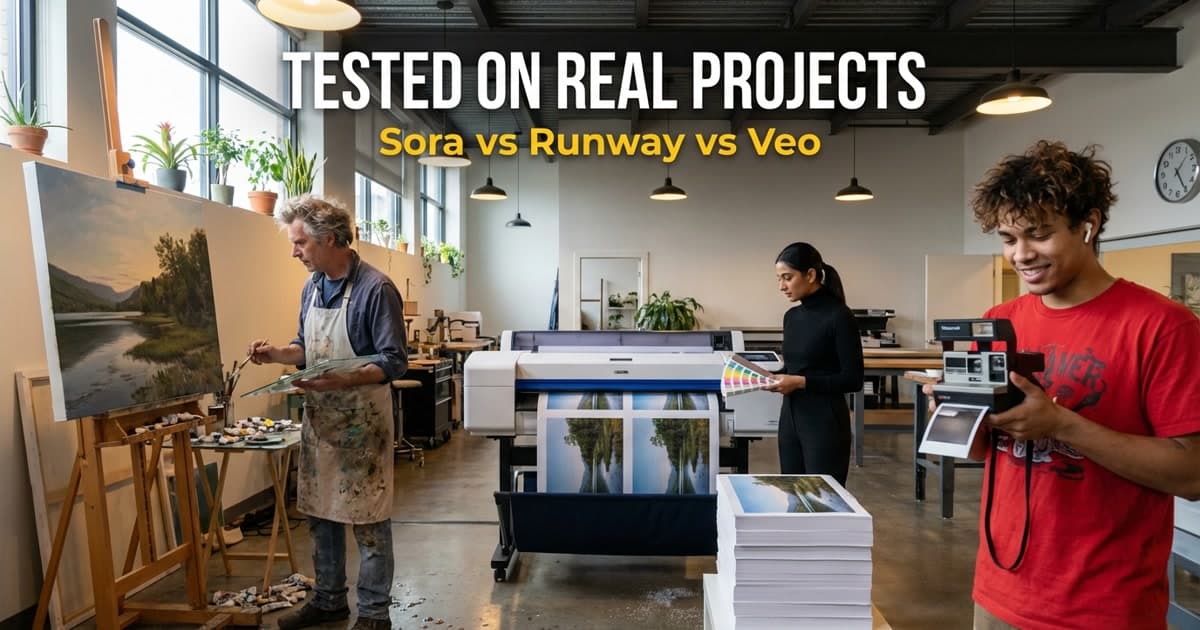
A Painter, a Printer, and a Polaroid Walk Into a Studio
By mid-2025, three AI video generation platforms dominated creator conversations: OpenAI's Sora, Runway Gen-3, and YouTube's native Veo model embedded in Dream Screen. Every creator agency, production house, and YouTube strategist had an opinion. Most of those opinions were wrong — because the debate was framed incorrectly.
"Which AI video tool is best?" is the wrong question entirely. It's like asking "which is better: an oil painting, a laser print, or a Polaroid?" The answer depends on what you're making and why. Sora is the master painter — peak quality, unpredictable brushstrokes, creates one-of-a-kind pieces that might be brilliant or might need to be scraped off and restarted. Runway is the professional printer — consistent output, precise control, reliable enough to build a production pipeline around. Veo is the Polaroid camera — instant, integrated, good enough for the moment, and you never have to leave the party to develop the film.
We tested all three against real production needs across our client portfolio. Here is what we found, what the marketing glosses over, and where each tool genuinely changes the production calculus.
Sora: The Master Painter (Peak Quality, Unpredictable Brushstrokes)
OpenAI's Sora — available from $20/month for Sora Plus to $200/month for the Pro tier — represents the quality ceiling of AI video generation. The output from complex Sora prompts is, under ideal conditions, indistinguishable from professional B-roll footage.
That ceiling is real. Sora's physics simulation, lighting coherence, and subject consistency across longer generations are meaningfully better than any competitor. For abstract concepts, product visualization without physical samples, and cinematic B-roll establishing shots, Sora consistently delivers production-quality results.
The tax: unpredictability at scale. Sora's output quality variance is high. A prompt that produces exceptional results on one generation may fail on the next identical prompt. Like a master painter — some canvases are masterpieces, some get painted over. Professional production workflows require predictability. This variance is manageable for experimental use. It's a workflow problem for primary production material.
Best use case: High-concept B-roll, abstract visualization, one-off hero sequences where quality ceiling matters more than consistency.
Runway Gen-3: The Professional Printer (Reliable, Controllable, Scalable)
Runway Gen-3 ($12/month for Standard, $28/month for Pro) occupies a different position. It is not trying to win the quality ceiling competition — it is optimized for production reliability.
Gen-3's frame-to-frame consistency is significantly stronger than Sora's for complex, multi-shot projects. The ability to maintain character appearance, environmental continuity, and color grading coherence across multiple clips is what separates Runway from tools built for standalone generations.
The platform's integration of motion control tools — precise camera movement specification, subject tracking, video-to-video transformation — gives editors and directors more control over output than any competing tool. For creators building AI-supplemented B-roll libraries, explainer visualizations, or product demo sequences, Runway offers the closest approximation to art direction in the AI generation space.
Gen-3's quality ceiling is lower than Sora's best output. But Gen-3's floor — the worst it produces — is meaningfully higher than Sora's worst. For production workflows, floor matters more than ceiling.
Best use case: Multi-clip AI sequences, explainer animation, product visualization where art direction matters, B-roll libraries for ongoing content production.
YouTube's Veo: The Polaroid Camera (Instant, Integrated, Good Enough)
YouTube's Veo model, integrated into Dream Screen for Shorts creation, is not trying to compete with Sora or Runway on output quality or creative flexibility. It is competing on integration depth and friction reduction.
For Shorts creators working inside YouTube Studio, Veo eliminates the export-import workflow that makes external tools cumbersome. Generate AI backgrounds, supplementary clips, or visual overlays without leaving the platform. The generated content is automatically optimized for Shorts format and aspect ratios.
Veo's output quality is adequate for Shorts use — the 9:16 format and mobile-first viewing context are more forgiving of AI generation artifacts than widescreen long-form content. For a Shorts creator producing 15-20 videos per week, Veo makes more economic and workflow sense than Sora or Runway even if the raw quality comparison favors the competitors.
Like a Polaroid: you trade quality ceiling for instant gratification and zero post-processing workflow. For the right use case, that trade is worth it.
Best use case: High-volume Shorts production, YouTube-native creators who want AI visuals without external tool workflow, creators building in YouTube Studio who need quick visual supplements.
What None of Them Can Replace
Here is the conclusion that every agency should be honest about: AI video generation tools, at their current state, are B-roll and supplementary footage tools. They are not primary content creation tools for channels where audience connection is the product.
We tested all three platforms against real client production needs — not abstract quality benchmarks, but specific use cases. For every client producing content where personality, expertise, demonstration, and human connection are the value proposition, AI-generated video reduced rather than enhanced content performance.
The channels where AI video added genuine value used it strategically: filling visual gaps in camera-shot content, creating abstract concept visualizations, and building Shorts supplementary content at volume. Across our portfolio, the highest-performing content in 2025 still relies on camera-original footage — authentic, unscripted moments, genuine expertise demonstration, and real human presence.
Our position: AI generates B-roll. Humans create the strategy, the story, and the connection. The painter, the printer, and the Polaroid are all tools. None of them replaced the creative director.
The Real Competitive Dynamics
The Sora vs. Runway vs. Veo comparison obscures the more important dynamic: all three platforms are racing toward the same improvements (extended length, better consistency, lower cost), while their differentiation comes from ecosystem integration and pricing.
Our prediction from late 2024 holds: AI video generation will become a commodity capability within 24-36 months. The tools that win will win on integration depth, not raw output quality. Runway's bet on production workflow tools, Veo's bet on YouTube integration, and Sora's bet on quality ceiling are all coherent strategies for different audiences.
For creators making tool choices today, the strategic decision is simpler: choose based on your workflow, not comparison videos. Runway if you're building multi-clip production sequences. Veo if you're building Shorts volume in-platform. Sora if you need occasional hero-quality AI sequences where budget per shot is not the constraint.
The painter, the printer, and the Polaroid will all improve. The question is which one sits on your desk — and that depends on what you're making, not which one won a benchmark test.
Frequently Asked Questions
Which AI video tool produces the best output quality in 2025?
At peak output, Sora produces the highest quality AI video generation — output that can be indistinguishable from professional B-roll. However, Sora's quality varies significantly between generations. For consistent production results across multiple clips, Runway Gen-3 has a higher floor and more predictable output. "Best quality" depends on whether you're optimizing for peak quality or production consistency.
How much does AI video generation cost for YouTube creators?
Mid-2025 pricing: Sora ($20-200/month), Runway Gen-3 ($12-28/month), YouTube's Veo (included with YouTube Studio for eligible creators). For a creator generating 5-10 supplementary AI clips per video, Runway Pro ($28/month) typically covers monthly usage.
Can AI-generated video replace human footage on YouTube?
Based on our testing across 50+ channels, AI-generated video does not replace camera-original content for channels where authenticity and human connection drive performance. AI video works best as supplementary B-roll, abstract visualization, and volume Shorts production. For primary content — interviews, tutorials, product demonstrations — human footage consistently outperforms.
Is YouTube's Veo available to all creators?
As of mid-2025, Dream Screen and Veo integration is available to YPP creators in select markets, with ongoing expansion. The tool is integrated into YouTube Studio's Shorts creation workflow and requires no separate subscription. Capabilities vary by region.
Will AI video generation improve enough to replace human production by 2027?
Quality will continue improving substantially. However, the channels that perform best on YouTube aren't those with the highest production quality — they're those with the most compelling strategy, strongest audience connection, and most distinctive creative voice. Those elements are developed, not generated. The floor for acceptable production quality will keep lowering, which makes strategic content more valuable, not less.