The Interpreter Booth Is Empty
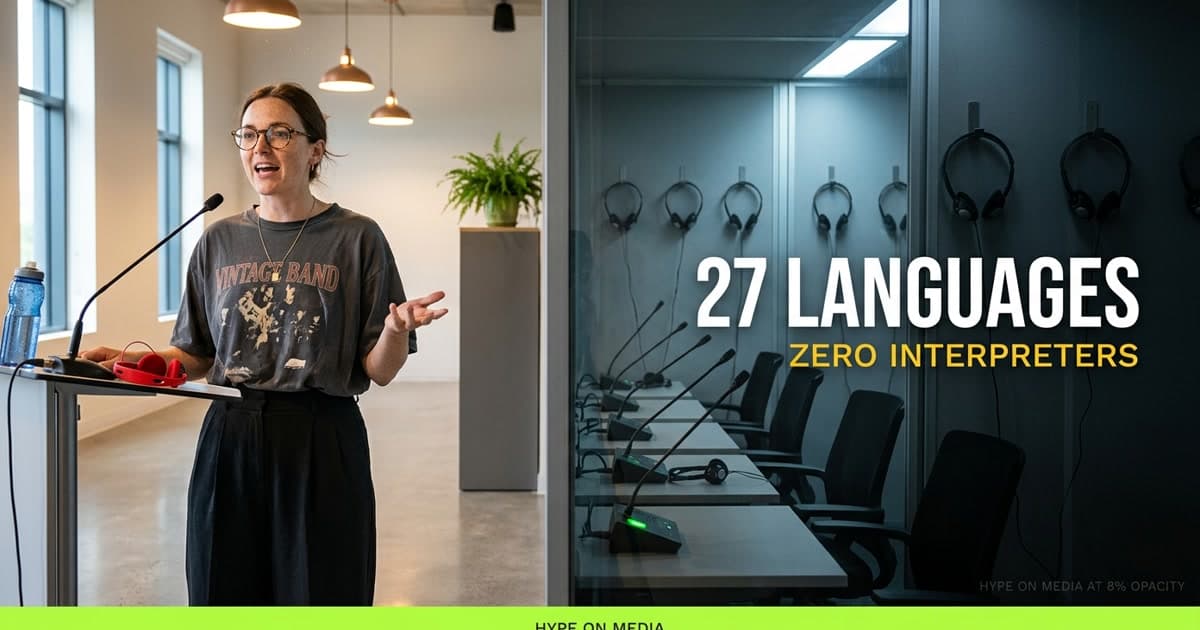
Picture a United Nations conference hall. Behind the glass, a row of interpreter booths — headsets hanging, microphones ready, 27 stations fully equipped. Except every chair is empty. No interpreters showed up. And the speaker at the podium does not care, because the AI behind the glass is translating her words into 27 languages simultaneously, matching her tone, her pauses, even the frustration in her voice when she says "this changes everything."
That is YouTube auto-dubbing in June 2025. One announcement, one morning, and 80 million YouTube Partner Program creators became multilingual overnight — without hiring a single translator, voice actor, or localization team. The interpreter booth is unmanned. The output is real.
We activated auto-dubbing across all eligible client channels on launch day and monitored 12 language pairs over 30 days. The result: dubbed versions collected 25-35% of total watch time on activated channels. One in four minutes watched was in a language the creator never spoke. That number does not refine a strategy — it rewrites it entirely.
How the Empty Booth Actually Works
YouTube's auto-dubbing pipeline runs three operations in sequence: transcription, translation, and voice synthesis. Understanding where each stage succeeds and fails is the difference between a channel that gains international traction and one that embarrasses itself in 27 languages simultaneously.
Transcription uses the same speech recognition models behind automatic captions. The system segments utterances, aligns them with video timelines, and identifies speaker changes. Channels with clear audio and single-speaker segments produce dramatically better dubbing output. Complex audio environments — background music, multiple speakers, ambient noise — degrade transcription accuracy, and every downstream error compounds.
Translation runs on neural models trained specifically on YouTube's content corpus. This matters: YouTube-specific vocabulary (subscriber counts, notification bells, channel mechanics) translates correctly where generic translation tools produce awkward phrasings. The models learned from video context, not Wikipedia articles.
Voice synthesis generates the dubbed audio track with timing adjusted to match original edit points. The system preserves speaking pace, emotional inflection, and vocal character — YouTube brands this as "Expressive Speech," launched for 8 languages in late 2025. This confirmed our earlier prediction that emotional fidelity would be the key unlock for professional adoption.
The output is a separate audio track per language, selectable through the viewer's language menu. The original video stays untouched.
Where the Empty Booth Breaks Down
The interpreter booth analogy holds — but so does its limitation. A human interpreter understands context, reads the room, catches irony. The AI interpreter translates words. Here is the honest quality assessment across dozens of client videos.
Where auto-dubbing performs well: Educational, informational, and tutorial content with clear single-speaker narration translates with high accuracy. The AI handles declarative sentences, step-by-step instructions, and factual content reliably. Spanish, French, and Portuguese dubbing — the highest-priority romance languages — consistently produce natural-sounding output for this content type.
Where quality gaps appear: Content built on humor, idiom, wordplay, or cultural reference loses significant value. A punchline constructed on English word structure does not survive translation into languages with different grammar. Channels where personality and vocal delivery are the primary value proposition — comedy, entertainment, personality-driven content — find that even technically accurate dubbing fails to capture appeal.
The accent and cadence problem: Auto-dubbed voices produce a recognizable AI character, even with Expressive Speech. Viewers in markets where AI voice synthesis is pervasive (Spanish, Portuguese, Chinese) are more tolerant. Viewers in markets where it remains unusual (Hindi, Indonesian, certain African markets) show higher abandonment rates.
Technical mismatch moments: Rapid topic changes, on-screen text references, and tightly coupled audio-visual content cause the pipeline to mistranslate context-dependent references. Tutorials referencing interface elements and reviews with on-screen product names require quality checking before relying on auto-dubbed versions as distribution.
The Strategy That Makes Auto-Dubbing Actually Work
Auto-dubbing is a distribution tool, not a content strategy. Activating the feature without adjusting your content approach is like giving the interpreter booth a script full of inside jokes — technically translated, practically useless.
At Hype On, we now include international audience reports in every client analytics review. The data consistently shows that international dubbed audiences exhibit different engagement patterns: higher replay rates (suggesting unfamiliarity navigating the content), lower comment rates (language barriers), but comparable watch completion rates for high-quality content.
The implication: optimize video structure for international consumption before relying on auto-dubbing to handle language. This means tighter visual storytelling — showing rather than telling — so viewers who miss nuance in the dub follow the content visually. It means minimizing cultural references that do not translate. It means clean editorial pacing rather than rapid-fire conversational style.
Channels that make these structural adjustments see 40-60% better international retention on dubbed content than channels that activate dubbing without structural consideration.
One approach we have implemented for several clients: a quarterly "international format" content block — videos produced with international distribution as the primary target. Visual clarity, universal appeal, language-agnostic structure. Produced in English, designed to travel. Auto-dubbing distributes them. The combination drives international subscriber acquisition at a fraction of localized production costs.
Activating and Monitoring: The Practical Setup
Activation requires YouTube Studio's Settings > Subtitles and dubbing section. Opt-in is required — nothing is automatically applied.
Language selection: YouTube supports 27 languages but you choose which to enable. Priority should follow existing international search traffic (visible in the Geography report) and target market size. Channels with no existing Spanish audience should still enable Spanish — dubbed content surfaces in Spanish-language search and suggested feeds independently.
Content filtering: Studio allows excluding specific videos from dubbing. Use this for content with heavy cultural references, complex humor, or confidential material that should not be auto-translated and published.
Quality review workflow: For brand-sensitive channels, implement a spot-check process — sampling 10-15% of auto-dubbed content in each language monthly catches quality issues before they accumulate audience complaints.
YouTube Studio's dubbing analytics show dubbed view counts, watch time by language, and retention curves for dubbed versus original audio. Review monthly. The data separates languages generating genuine audience engagement from passive view accumulation.
What Comes After the Empty Booth
The progression is clear: auto-dubbing is layer one. Creator voice cloning, localized thumbnail generation, and region-specific recommendation optimization are already in development.
The channels that invest in understanding international audience behavior now — while auto-dubbing is novel and early-adopter advantage exists — will be positioned better when those features launch. Building an international audience takes time regardless of how good the tools become. Auto-dubbing compresses the technical barrier. It does not compress the time required to build genuine loyalty in a new language market.
We are already testing voice-cloned dubbing workflows for select clients using third-party tools — maintaining the creator's actual voice characteristics across dubbed versions. YouTube's first-party version is coming. The channels piloting it now will have the operational knowledge to deploy at scale when it arrives.
Frequently Asked Questions
Which languages does YouTube auto-dubbing support in 2025? As of June 2025, YouTube auto-dubbing supports 27 languages including Spanish, Portuguese, French, German, Hindi, Indonesian, Japanese, Korean, Italian, Dutch, Polish, Turkish, and Tagalog. Expressive Speech (emotional voice preservation) launched for 8 languages: English, Spanish, French, Portuguese, German, Italian, Hindi, and Indonesian. YouTube continues expanding language support quarterly.
Do auto-dubbed videos count toward channel watch time and revenue? Yes. Watch time on auto-dubbed versions counts toward channel metrics and monetization. Ad revenue from dubbed views is attributed to the original channel. International CPMs vary — Spanish and Portuguese rates are generally lower than English, but volume-driven earnings offset the difference at sufficient international scale.
Can viewers tell the difference between auto-dubbed and human-dubbed content? In most cases, yes. AI-dubbed audio has recognizable characteristics: slightly even pacing, reduced vocal variation, occasional awkward emphasis. Viewer tolerance is high for informational content and lower for entertainment. Our recommendation: disclose AI dubbing in descriptions for audiences that expect human performance.
Should channels translate titles and descriptions for dubbed content? YouTube auto-generates translated titles and descriptions. Quality is functional but imperfect for SEO-optimized titles with cultural nuance. For channels with significant international revenue potential, manually review and edit translations in your top 3-5 priority languages.
What happened to watch time on channels that activated dubbing? Across our 12+ activated client channels in the first 30 days, dubbed versions generated 25-35% of total watch time. This was almost entirely additive — native-language audience behavior showed no meaningful change. International uplift was highest for informational content and lowest for entertainment.