The Platform That Became a Country
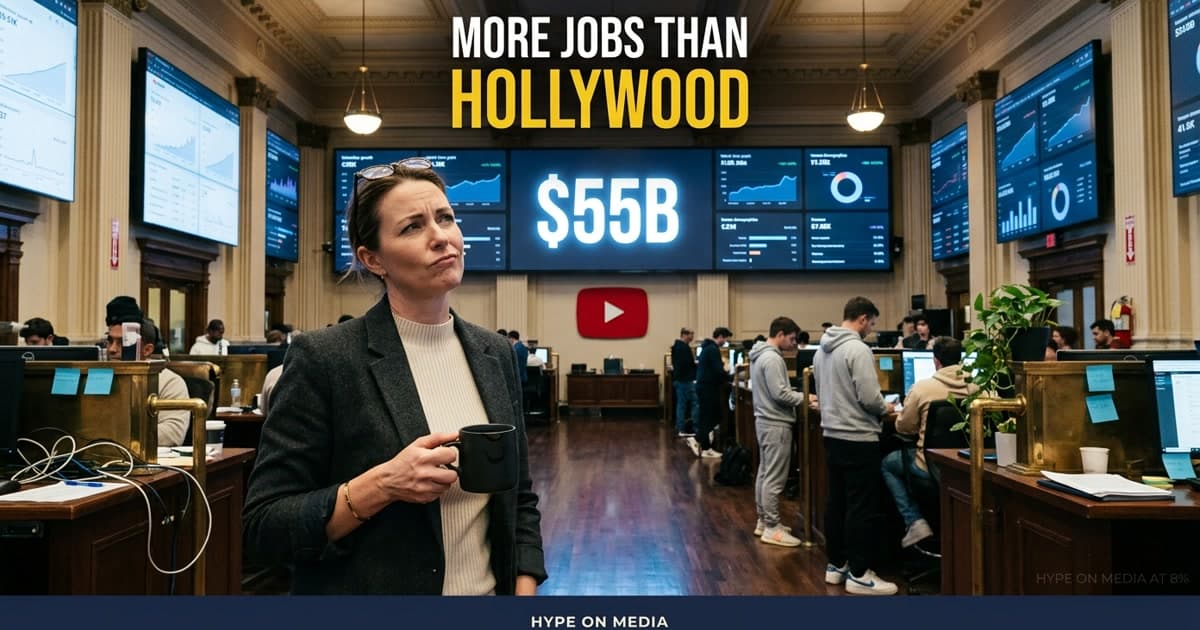
Imagine walking onto the floor of the New York Stock Exchange — the cathedral ceiling, the trading terminals, the wall of screens flashing numbers. Now look closer. The screens are not showing stock tickers. They are showing YouTube analytics: subscriber curves, watch time graphs, revenue dashboards. The traders are not wearing floor badges — they are wearing creator merch. And the number on the main board does not say "DJIA 42,000." It says "GDP: $55,000,000,000."
That is not a metaphor for what YouTube might become. It is what YouTube's 2024 economic impact report already documents: $55 billion in US GDP contribution and 490,000 full-time equivalent jobs — more people employed than the entire US film and television production industry. YouTube's creator ecosystem is now, by headcount, larger than Hollywood.
These numbers are the proof point we share with every prospective client who asks whether YouTube is "worth the investment." YouTube is not a social media platform you should probably try. It is a $55 billion economic engine, and professional content is the fuel. The GDP data makes the business case in language that finance teams understand.
Breaking Down the $55 Billion
The headline number bundles several distinct economic mechanisms. Understanding them separates informed investment decisions from impressionistic ones.
Direct creator earnings — ad revenue, memberships, Super Chat, Shopping affiliates — represent one layer. YouTube paid over $70 billion to creators, artists, and media companies over the three years ending 2024. This is money flowing from advertisers through YouTube to content creators, most of whom spend it in their local economies.
Indirect economic activity — the production crews, editors, designers, music producers, and business services supporting creator operations — is the second and larger layer. A YouTube channel with 2 million subscribers is typically a small business employing 3-8 people, sourcing equipment and services, generating economic activity well beyond direct creator earnings.
Platform-enabled commerce — products and services sold through YouTube's advertising and affiliate infrastructure — represents the third layer. This includes both direct YouTube Shopping conversions and offline purchases influenced by YouTube content. The econometric modeling for this layer is conservative; actual commerce influence is likely significantly higher.
Talent development and spillover — creators who develop skills that generate income in other contexts, entertainment professionals sourcing talent from YouTube, and the millions using tutorials to build professionally valuable skills — is the most difficult to quantify and most underappreciated layer.
What 490,000 Jobs Actually Means
The employment figure is a more concrete benchmark than the GDP headline.
These are real jobs across a diverse range: full-time creators with three-person production teams, video editors working with five different clients, talent managers representing 20 mid-sized channels, brand deals agencies, merchandise companies specializing in creator drops, equipment rental houses whose client base shifted from film to YouTube over the past decade.
The majority did not exist in their current form fifteen years ago. YouTube created an economic category — the creator economy — that has become a genuine employment sector. Growth from 390,000 jobs in 2022 to 490,000 in 2024 suggests the sector is expanding at ~12% annually, faster than most traditional media employment.
For brands evaluating channel investments, this employment scale indicates depth and maturity. Channels supported by professional teams — editors, scriptwriters, strategists, analytics managers — consistently outperform solo-creator channels on every performance metric. The professionalization of the creator economy means the bar for competitive content has risen, but the infrastructure to produce it at scale also exists.
Why B2B Brands Are Finally Paying Attention
The GDP and employment numbers correlate with a shift we have observed directly in client conversations over 18 months: B2B brands are taking YouTube seriously in a way they were not in 2022.
The historical hesitation was understandable. B2B purchase cycles are long. Attribution between a YouTube view and a six-month enterprise sale is difficult. The assumption was that YouTube audiences were consumers, not business decision-makers.
That assumption is wrong, and the data is now unambiguous. LinkedIn's own research shows 70%+ of B2B decision-makers use YouTube as a professional research channel. Technology buyers watch demos, comparisons, and testimonials before vendor decisions. Finance professionals follow thought leaders. Operations managers reference tutorials in their workflows.
We predicted in late 2024 that the GDP report would accelerate B2B investment. The data confirms: B2B YouTube ad spend grew 32% year-over-year in 2025, the fastest-growing B2B video channel by a significant margin. Channels making strategic bets on B2B YouTube content now are building audience and SEO authority ahead of the mainstream wave.
The Investment Framework This Data Supports
For marketing leaders, the $55 billion context reframes YouTube investment in four ways.
YouTube is infrastructure, not a campaign. The GDP contribution is driven by sustained creator operations, not single campaigns. Brands that treat YouTube as a sustained channel — building audience, authority, and SEO equity over 12-24 months — generate compounding returns. Campaign-only approaches generate campaign-level results: visible during, gone when spending stops.
The employment data signals quality stratification. The gap between professionally produced and solo-creator channels is widening. In competitive categories, channels with professional production, strategic scripting, and data-driven optimization dominate. Brands investing in production quality now capture audience segments that become increasingly difficult to reach once a competitor owns attention.
International expansion multiplies returns. The $55 billion captures US impact only. YouTube's 2 billion+ monthly global users suggest global GDP contribution would dwarf the US figure. The June 2025 auto-dubbing expansion signals the next growth phase. Brands with global footprints and YouTube strategies designed for international distribution capture this growth first.
Channel authority compounds like equity. A YouTube channel with 500,000 subscribers in a specific category represents years of audience trust, algorithmic signal, and search equity that cannot be replicated quickly. Brands that build channel authority in underserved segments now will face far higher acquisition costs for comparable authority in two years.
The Real Question for Budget Allocation
The GDP and employment data document what YouTube has become. The strategic question is how to position relative to what it is becoming.
Our working thesis: YouTube is transitioning from a supplementary marketing channel to a primary digital presence for any brand where thought leadership, product education, or customer relationship depth matter. The brands that make this transition earliest — building genuine channel equity and audience loyalty — will have structural advantages over later entrants.
The $55 billion figure is not a reason to invest in YouTube. It is confirmation that investing in YouTube has already worked for tens of thousands of businesses. The question is not whether YouTube generates returns. It is whether your brand is generating them.
Frequently Asked Questions
How does YouTube's $55B GDP contribution compare to other platforms? YouTube's contribution makes it one of the largest individual platform economic contributors in the digital economy. The entire US video game industry contributes approximately $100 billion to GDP. Meta's platforms combined contribute an estimated $200 billion globally, but their model is more advertiser-oriented than creator-economy-driven. YouTube's figure is notable because a significant portion flows to creators — individuals and small businesses — rather than accumulating in platform earnings.
What does the $70B paid to creators over three years mean for individual creators? The $70 billion distributes very unevenly. The top 1% of monetized channels receive a disproportionate share. However, the middle tier — channels with 100,000 to 2 million subscribers in specific niches — represents the highest-growth segment. Our data shows professionally managed channels in this range generate $50,000 to $500,000 annually from combined revenue sources.
Should B2B companies invest in YouTube given these numbers? Yes, selectively. The relevant question is category penetration — whether your specific audience uses YouTube for professional research. For technology, software, finance, marketing, and professional services, the answer is definitively yes. For specialized industrial or government sectors, the audience may be smaller but often entirely uncontested. A well-positioned B2B channel in an uncontested category generates search and recommendation equity that functions as evergreen inbound for years.
How reliable is YouTube's self-reported economic impact data? YouTube commissions impact reports from independent economic research firms using established GDP methodologies. The methodology is transparent and peer-reviewed. Like all entity-commissioned impact studies, the numbers favor positive framing — they capture economic contribution but do not offset against platform costs. The numbers are genuine; the framing is predictably promotional.
What is the creator economy's projected GDP contribution by 2027? At the 2022-2024 trajectory (US GDP contribution grew from $35B to $55B, approximately 25% over two years), US contribution could approach $70-80B by 2027. Global figures will grow faster. Auto-dubbing expansion and AI production tools lowering the quality floor will both drive increased participation. Independent projections suggest the global creator economy will exceed $500B in annual output by 2027.