Most YouTube channels are making strategy decisions based on a number that lies to them.
Aggregate CTR collapses two entirely different audience behaviors — cold discovery and loyal return — into a single metric. A channel with a 5% aggregate CTR might have returning viewers clicking at 9% and new viewers at 2.1%. Those are two different problems with two different solutions. The aggregate number hides both of them.
In March 2024, YouTube rolled out new vs returning viewer filters across impressions, CTR, and watch time in YouTube Studio Analytics. We had been pulling this split via the YouTube Data API and building custom dashboards around it for months before the native rollout. When YouTube made it available to everyone, it confirmed what we had already operationalized: the split is one of the most diagnostic signals in the entire analytics suite.
What the New vs Returning Viewer Split Actually Measures
The new vs returning viewer split separates your analytics into two distinct audience segments. New viewers have never watched your channel before — they arrive through search, suggested videos, or external links. Returning viewers have watched at least one of your videos in the previous 28 days and have an established relationship with your content.
YouTube's filter lets you compare impressions, click-through rate, average view duration, and watch time between these two groups independently. The numbers are almost always meaningfully different, and the gap reveals where your funnel is broken. New viewers make cold decisions — they see your thumbnail in a crowded feed with no prior brand relationship. Returning viewers already trust your content; they click based on familiarity. Aggregating these two groups hides which audience is performing and which is dragging metrics down.
The Most Common Problem This Data Reveals
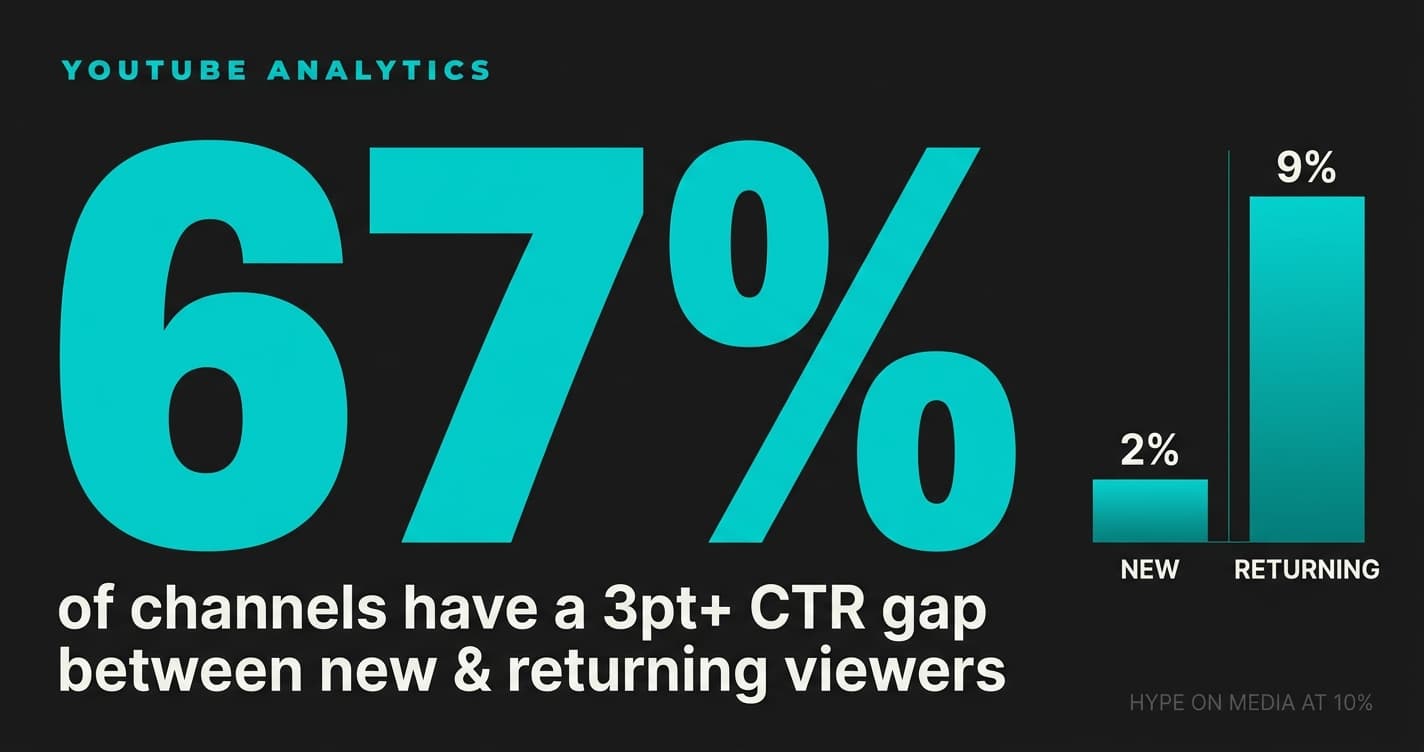
Across our portfolio of 50+ channels, we analyzed new vs returning viewer data after the rollout and found a consistent pattern: 67% of channels showed a CTR gap of 3 or more percentage points between the two segments, with returning viewers clicking at dramatically higher rates.
On the surface, this sounds like a positive — loyal viewers love your content. But it masks a critical acquisition problem. Your thumbnails and titles are resonating with people who already know you and systematically failing to attract anyone new. The channel is converting loyalty, not building it.
The inverse problem exists too. Channels that chase trending topics often show high new viewer CTR but collapsing returning viewer rates. Every upload resets the relationship. There is no compounding audience, no loyal base, no channel-level trust that accumulates between videos.
The optimal pattern — which fewer than 20% of channels exhibit — shows both new and returning viewer CTR above benchmark, with new viewer watch time within 10-15% of returning viewer watch time. This is the signature of content that works for discovery and retains new viewers well enough to convert them into returning ones.
How to Read Your Split and Diagnose the Problem
Pull your split data first. In YouTube Studio: Analytics → Reach → Impressions and click-through rate → "Viewer type" comparison filter. Run the same analysis for Average view duration under the Engagement tab. Four scenarios cover the vast majority of what you'll find.
High returning CTR, low new CTR: Your thumbnails work for loyal viewers but fail as cold discovery assets. They likely rely on recognizable branding, familiar faces, or series-specific context that new viewers don't have. Fix: test thumbnails designed for complete strangers — no assumed context, clear value proposition, universal visual language.
Low returning CTR, high new CTR: You attract new viewers through clickable packaging, but they don't return. The content isn't delivering on what the thumbnail implies, or there's no hook to bring them back. Fix: analyze the first 30 seconds of top-performing new-viewer videos and identify whether the hook matches the thumbnail's implied promise.
Both CTR metrics strong, new viewer watch time low: Discovery is working but new viewers aren't staying. Content may assume too much context or move too fast for cold audiences. Fix: add brief viewer context at the 30-second mark without boring returning viewers — "if you're new here, here's what this channel is about" before diving into depth.
Both metrics weak: Systematic issue requiring a full content audit, not incremental optimization. No amount of thumbnail A/B testing fixes a positioning problem.
The Hype On Approach to Funnel Segmentation
Our analytics framework for every managed channel separates content performance by audience type from day one. Before YouTube's native rollout, we pulled this data via the Analytics API and built dashboards that tracked new viewer acquisition rate alongside returning viewer retention score as parallel KPIs.
The operational insight we had codified before the feature went public: content should be intentionally designed for one primary audience type, with elements that serve the secondary type. A new-viewer acquisition video needs a cold-audience hook, universal context, and a strong subscribe prompt. A returning-viewer content video can assume context, reference previous uploads, and reward loyalty with depth.
One client — a B2B SaaS company with a channel built around product tutorials — had an 8.3% returning viewer CTR and a 1.9% new viewer CTR when we took over. After restructuring their thumbnail strategy to treat new and returning viewers as separate creative briefs, new viewer CTR rose to 4.7% within three months. Channel growth rate increased 3.1x. The content quality did not change. The targeting of the creative did.
Building a New Viewer Acquisition System
Understanding the split is the diagnostic. Building a system around it is the actual work.
Step 1: Classify every upcoming video by primary audience type. Some videos are discovery vehicles — optimized to pull in new viewers from search and suggested. Others are loyalty engines — rewarding your existing audience with depth, series continuity, or community content. Both have value. Most channels produce the second type almost exclusively and wonder why growth stalls.
Step 2: Assign thumbnail and title briefs accordingly. Discovery video thumbnails should be tested on audiences with zero prior channel knowledge. Show the thumbnail to someone unfamiliar with your brand and ask: "What do you think this video is about?" If they can't answer accurately, the thumbnail is failing cold audiences. Loyalty video thumbnails can use series branding, recurring characters, and in-community references.
Step 3: Track new viewer conversion rate week over week. The metric to watch is the percentage of new viewers who watch a second video within 28 days. YouTube doesn't surface this directly, but you can approximate it by monitoring your returning viewer percentage over time. Channels with strong conversion systems see this metric climb steadily. Channels without one plateau — sometimes indefinitely.
Step 4: Optimize your new viewer landing experience. The videos a new viewer sees first determine whether they return. Identify which videos are generating the most new viewer impressions (sorted by impressions, filtered to new viewers only) and audit them for cold-audience conversion. These are your acquisition frontline — they determine whether a new impression becomes a returning viewer or a one-time bounce.
What's Coming: Deeper Audience Segmentation in Studio
YouTube's 2024 rollout of new vs returning viewer filters is a first step toward full audience segmentation inside Studio. Based on patterns we've observed in beta feature rollouts, the next iteration will likely include cohort analysis — tracking how specific batches of new viewers behave across a multi-video journey, not just their first interaction.
The channels building strategy around audience segmentation now will have a structural advantage when YouTube makes these tools more granular. Audience intelligence — not content volume — is the differentiator in 2024 and beyond. The channels grinding out uploads without distinguishing who those uploads are for will keep hitting the same growth ceiling.
The split is already in your Studio. The question is whether you're using it to drive decisions or ignoring it in favor of aggregate numbers that hide what's actually happening.
Frequently Asked Questions
What counts as a "new" viewer on YouTube?
A new viewer is someone who has not watched any video on your channel in the previous 28 days. YouTube resets this window on a rolling basis, so a viewer who watched your channel six weeks ago but not since would be classified as new if they return today. This means "new viewer" includes both first-time discoverers and lapsed subscribers re-engaging with your content.
How do I access the new vs returning viewer split in YouTube Studio?
Navigate to YouTube Studio → Analytics → Reach tab. Click on "Impressions click-through rate" and look for the "Viewer type" comparison option in the dropdown. You can also access this filter in the Engagement tab under Average view duration. The feature rolled out to all channels in March-April 2024.
Should I create separate videos for new and returning viewers?
Not entirely separate — but you should design every video with a clear primary audience in mind. Discovery-optimized videos prioritize universal hooks and cold-audience clarity. Loyalty-optimized videos can assume context and reward depth. A healthy channel publishes both types intentionally, rather than defaulting to one by accident.
What is a healthy gap between new and returning viewer CTR?
Based on our portfolio data, a gap under 2 percentage points indicates strong universal thumbnail performance. A gap of 3-5 points suggests the thumbnail relies on brand familiarity. A gap above 5 points signals that acquisition thumbnails need significant redesign — new viewers are systematically not clicking at rates that can sustain channel growth.
How does this data affect upload frequency strategy?
Channels that publish fewer, higher-quality videos tend to show stronger new viewer acquisition metrics because each upload is properly optimized for both audience types. High-frequency channels often show the opposite — uploads optimized for loyal audiences while new viewer acquisition stagnates. If your new viewer CTR is below 3%, frequency is almost never the fix.