The Skyscraper Nobody Acknowledged
Imagine a skyscraper under construction downtown. Every quarter, another 15 floors go up. It has already grown taller than the banks, taller than the hotels, taller than every newspaper headquarters combined. Tenants are moving in by the thousands. The building generates more economic activity than some countries. And the city's urban planners are still debating whether it counts as "a real building."
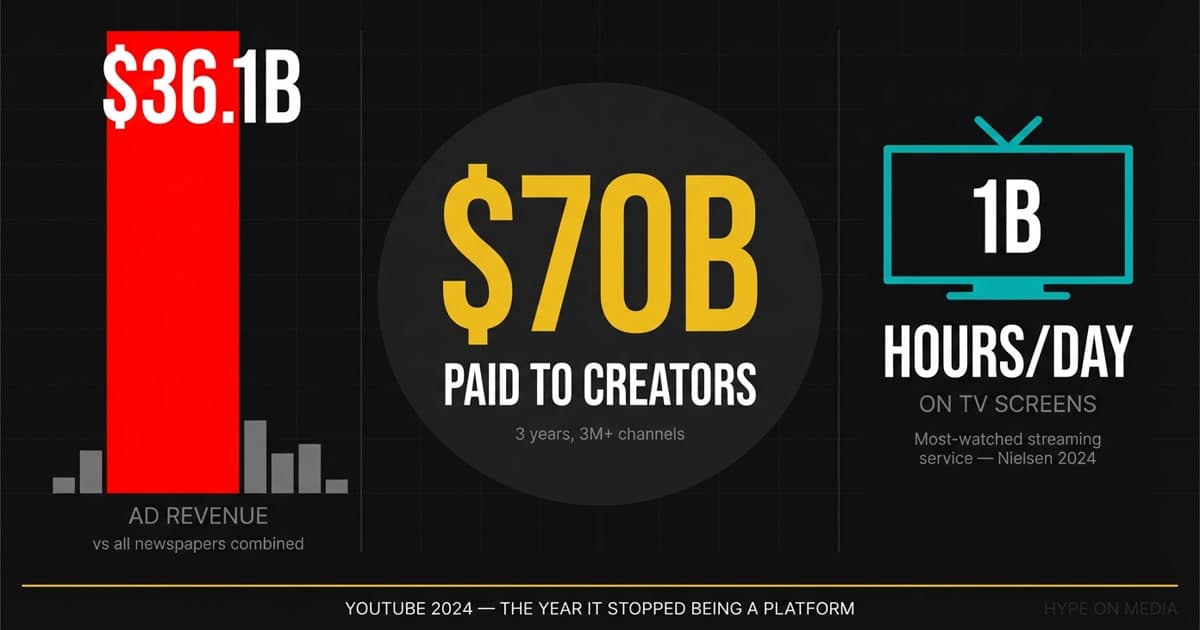
That is YouTube in 2024. The platform closed the year with $36.1 billion in advertising revenue — larger than the entire global newspaper advertising industry combined. It paid creators $70 billion over three years. Viewers watched 1 billion hours per day on television screens alone. And somewhere, a marketing VP is still writing "explore YouTube" on their Q2 roadmap like it is an experiment to consider.
YouTube did not have a good year. YouTube stopped being a platform and became infrastructure — as fundamental to media distribution as electricity is to buildings. You do not debate whether to connect to the power grid. You calculate how much capacity you need. These are the numbers that make that case, and what each one means for brands still treating the tallest building in the skyline as optional.
$36.1 Billion: The Ad Revenue Milestone
YouTube's advertising revenue reached $36.1 billion in 2024, up from $31.5 billion in 2023. That 14.6% year-over-year growth significantly outpaced the broader digital advertising market, which averaged roughly 10% over the same period.
Two structural shifts drove the outperformance, and neither is reversing. TV viewership is migrating to YouTube, bringing premium Connected TV (CTV) advertising that commands CPMs rivaling linear television. Brands that allocated television budgets to YouTube as experiments in 2023 made permanent reallocations in 2024. And YouTube's self-reported attribution data shows that 70% of viewers say the platform helps them discover new brands — top-of-funnel impact that translates into measurable lift.
Our portfolio data reinforces this: across 50+ managed channels, brands that combined organic content with paid YouTube advertising saw 2.3x higher brand search lift than those running paid campaigns without organic presence. The ad revenue story is inseparable from the organic content story — they compound each other.
$70 Billion to Creators: The Employment Revolution
YouTube confirmed that the platform paid more than $70 billion to creators, artists, and media companies from 2021 to 2023. In 2024 alone, the platform crossed 3 million channels in the YouTube Partner Program.
These are not vanity metrics. YouTube has effectively become the largest employer of video talent in human history — not through direct employment, but through a revenue-sharing model that turned content creation into a viable career for millions. The $70 billion figure means more money has flowed from YouTube to individual creators than some countries' entire GDP over the same period.
For brands evaluating YouTube as a marketing channel, the creator economy number has a specific implication: the talent supply for sponsored content, partnerships, and brand integrations is larger and more sophisticated than ever. The cost of premium creator access has risen — but so has the quality and accountability of the output. 3 million Partner channels means 3 million potential distribution partners with built-in audiences and monetization incentives to produce consistently.
1 Billion Hours on TV: The Living Room Takeover
The most consequential number in YouTube's 2024 report — the one most brands have not fully processed: viewers watch over 1 billion hours of YouTube content per day on television screens. Not total viewing. Not desktop plus mobile. Television screens specifically.
YouTube is no longer competing with Instagram Reels for mobile attention. It is competing with Netflix, HBO Max, and live sports for the living room. Nielsen's streaming rankings for 2024 confirmed what the billion-hours figure implies: YouTube was the most-watched streaming service in the US for the entire year, defeating every paid subscription service.
The platform that gives content away for free, supported by advertising, beat every premium subscription service for total viewing time. The skyscraper is taller than everything else on the block — including the buildings that charge admission.
This changes the creative brief for YouTube content. Vertical mobile-first production underperforms on TV screens, where horizontal widescreen, higher production values, and longer session times are the norm. We have been advising clients on TV-optimized production since early 2024 — our data shows horizontal long-form content generates 40% more impressions from TV-placement audiences than the same channels' Shorts content.
$55 Billion GDP and 490,000 Jobs: The Infrastructure Argument
An Oxford Economics study cited in YouTube's 2024 report found the platform contributed $55 billion to US GDP and supported 490,000 full-time equivalent jobs across the creator economy, advertising supply chain, and production ecosystem.
When a platform reaches this scale of economic integration, it occupies infrastructure-level importance. Electricity contributes to GDP. Roads support jobs. YouTube now sits in the same category — not as a metaphor, but as a measurable economic fact. Regulatory pressure, content moderation debates, and brand safety concerns all play out against this backdrop: the building is too big, too connected, and too embedded in the economy to become irrelevant.
For brands, this validates YouTube as a durable investment rather than a trend channel. Platforms with this level of economic integration do not disappear. They evolve, but the businesses built on their foundations survive the evolution. The skyscraper is not getting demolished. The question is which floor you occupy.
What the Numbers Mean for 2025 Strategy
Every metric in YouTube's 2024 data tells the same story: the platform is growing faster than the market, paying creators more, reaching more viewers on premium screen real estate, and generating more economic activity than its public reputation captures. The building passed "tallest on the skyline" two years ago. The 2024 numbers confirm it is now the skyline.
The compounding math is unforgiving. Channels publishing consistently for 12+ months generate 4x the pipeline per video compared to their first 90 days. The 3 million Partner channels mean the bar for standing out rises every quarter. The $70 billion creator payout means the competition for audience attention is capitalized at levels most brands have not matched.
We predicted at the start of 2024 that YouTube's ad revenue would outpace the digital market. At $36.1 billion, it did. We predicted TV viewership would become the primary growth vector. The billion-hours-per-day figure confirmed it. For 2025, the critical insight is this: the brands capturing the most value from YouTube's continued growth are those investing in production quality and content consistency now, before the inflection point makes those investments more expensive and more competitive.
YouTube is not a channel you test. It is infrastructure you build on — deliberately, with a long-term framework, or not at all. The 2024 numbers do not suggest this. They prove it.
Frequently Asked Questions
How much did YouTube earn in advertising revenue in 2024?
YouTube reported $36.1 billion in advertising revenue for 2024, a 14.6% year-over-year increase from $31.5 billion in 2023. This growth rate outpaced the broader digital advertising market's approximately 10% growth, reflecting YouTube's strengthening competitive position driven by Connected TV adoption and premium ad inventory.
How much has YouTube paid creators in total?
YouTube paid more than $70 billion to creators, artists, and media companies from 2021 to 2023. In 2024, the platform surpassed 3 million channels in the YouTube Partner Program, making it the largest revenue-sharing video platform by both payout volume and creator participation.
How many hours of YouTube are watched on TV screens daily?
YouTube viewers watch over 1 billion hours of content per day on television screens alone. This figure, combined with Nielsen data showing YouTube as the most-watched streaming service in the US for 2024, positions the platform as a direct competitor to Netflix, linear television, and premium streaming services.
Is YouTube bigger than Netflix in viewership?
Yes, by total viewing time in the US. Nielsen's 2024 streaming rankings showed YouTube as the most-watched streaming platform for the full year, surpassing Netflix, Hulu, Disney+, and all paid subscription services. YouTube's combination of free access, content breadth, and TV-screen growth gives it a structural advantage in total hours watched.
What does YouTube's $55 billion GDP contribution mean for brands?
YouTube's $55 billion US GDP contribution and support of 490,000 jobs demonstrate that the platform has reached infrastructure-level economic importance. For brands, this means YouTube is a durable investment — platforms with this scale of economic integration do not become irrelevant. Building a YouTube presence is building on infrastructure that will outlast any single marketing trend.