The Lure That Catches Keepers
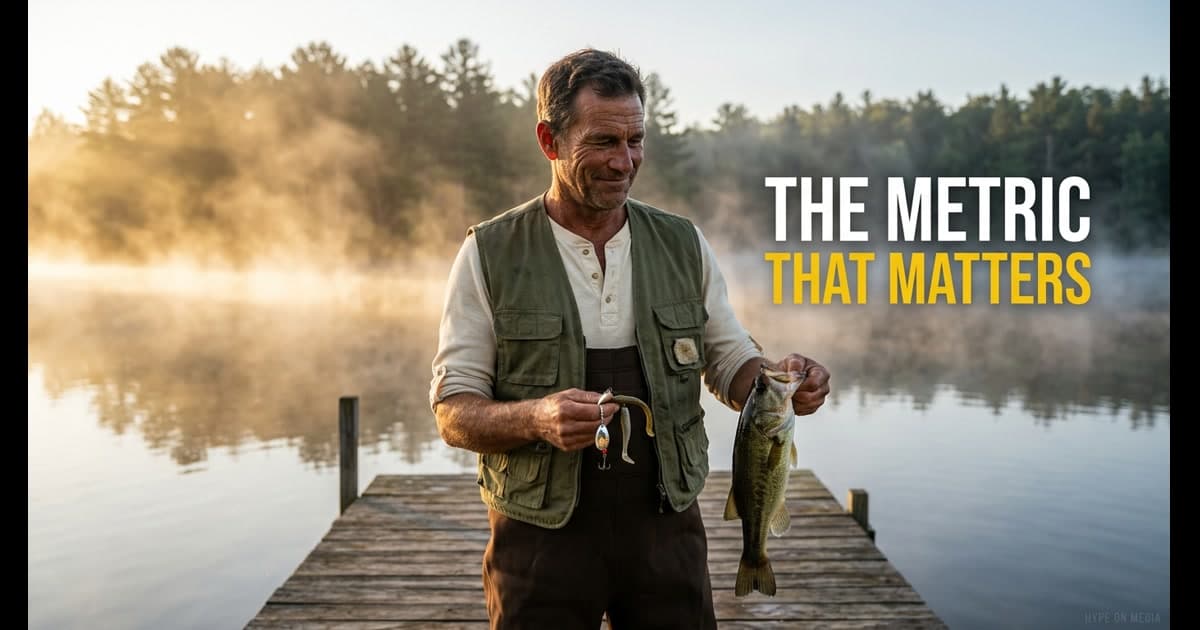
Picture a fisherman standing on a dock at dawn, mist curling off a glassy lake, three lures fanned out in one hand and a largemouth bass in the other. One lure is flashy — a chrome spinner that catches everything that swims. One is subtle — a soft plastic worm, slow retrieve, patience required. One is scented — designed to attract only the species worth keeping. The flashy lure fills the net every single cast. The scented lure fills the cooler. And the fisherman who has been doing this long enough knows exactly which one he is reaching for at dawn.
A thumbnail that generates the highest click-through rate is the chrome spinner. It hooks every curious scroller who drifts past — and half of them leave within eight seconds, dragging your average view duration into the mud, sending a signal to the algorithm that your content fails to deliver on its promise. YouTube understood this problem before most creators did. They built the solution into a feature that almost nobody fully understands.
In April 2024, YouTube rolled Test & Compare to over 50,000 creators. Upload up to three thumbnails. The platform splits impressions. A winner emerges. But the winning metric is not click-through rate. It is watch time share — the percentage of total watch time each thumbnail variant generates. That single design choice changes everything about how you should evaluate thumbnails, because it means YouTube is measuring keepers, not total catch.
At Hype On, we have been running structured thumbnail tests with third-party tools for three years before YouTube built this natively. We migrated every active client into a systematic test cycle within the first week of launch. After 200+ controlled tests across 50+ channels, the data told a story that quietly contradicts what most thumbnail optimization guides still teach.
How Test & Compare Actually Works
YouTube's Test & Compare lets you upload two or three thumbnail variants for any published video. The platform distributes impressions using a multi-armed bandit algorithm — it initially splits traffic roughly evenly, then increasingly favors whichever variant performs better over time. This means a clear winner often surfaces faster than a traditional 50/50 A/B test, but it also means losing variants accumulate fewer total impressions as the experiment progresses. Never compare raw view counts between variants. Compare the watch time share percentage that YouTube reports in the results panel.
To access it: open YouTube Studio, navigate to the Content tab, click any video, and find Test & Compare in the thumbnail section. Upload your variants and set a test duration. YouTube recommends a minimum of 14 days for statistical significance, though videos with high daily traffic produce meaningful data in as little as 48 to 72 hours.
The detail most optimization guides skip: the feature works on any published video regardless of age. Older videos with established traffic patterns actually produce faster, more reliable results because their daily impression volume is predictable and stable. We have run tests on videos that were two years old and seen measurable improvements in recommendation volume within three weeks of applying the winning thumbnail.
Why Watch Time Share Beats CTR — and When High CTR Hurts You
This is where the fisherman analogy earns its keep. CTR measures curiosity. Watch time share measures qualified interest. They are related but distinct signals, and optimizing for the wrong one actively damages your channel's algorithmic standing.
Across our portfolio of 50+ channels and 200+ controlled experiments, we documented a pattern that Test & Compare now confirms algorithmically: the thumbnail with the highest CTR wins only about 60% of the time. In the other 40% of tests, a thumbnail with a measurably lower click-through rate produces a higher watch time share — and that lower-CTR thumbnail is the one YouTube declares the actual winner.
The mechanism is audience matching. A sensationalized thumbnail — dramatic facial expressions, misleading text overlays, exaggerated arrows pointing at nothing — generates clicks from people who feel misled the moment the video starts playing. They leave within 15 to 30 seconds. YouTube's algorithm reads that rapid drop-off as a strong negative signal. The video gets fewer recommendations. The "high-performing" thumbnail is actively sabotaging the video's long-term discoverability.
A thumbnail that accurately represents the content while creating genuine visual interest attracts fewer but better-matched viewers. Those viewers stay through the video. They watch related content. They subscribe. In our testing data, the watch-time-optimized thumbnail outperforms the click-optimized one by 18 to 24% in 90-day recommendation volume. That gap compounds with every video in your library.
The fisherman knows this in his bones. The chrome spinner fills the net with bycatch that has to be thrown back overboard. The scented lure catches fewer fish, but the fisherman goes home with a full cooler and nothing wasted. YouTube's algorithm is the fisherman — it rewards the lure that catches keepers.
The 4-Signal Framework We Run Before Every Test
Before uploading variants to Test & Compare, every thumbnail at Hype On passes through our 4-Signal Thumbnail Framework. The goal is not to find the best thumbnail — it is to ensure every variant you test is already competitive. You want to test between strong options, not sort good from mediocre.
Signal 1: Contrast. Does the thumbnail remain visually distinct on both light and dark backgrounds? YouTube alternates between white-mode and dark-mode feed layouts depending on user settings. A thumbnail that pops on dark but vanishes on white loses up to 40% of its potential impressions. We test by viewing the thumbnail at 120px wide on both backgrounds — the actual size most viewers encounter it in their subscription feed.
Signal 2: Face positioning. If a human face is present, is it in the left two-thirds of the frame? Eye-tracking studies consistently confirm left-to-right scanning patterns on thumbnails in Western markets. Faces positioned right-of-center receive measurably less initial dwell time. Expressions must be definitive, not ambiguous — a clear emotional signal reads faster than subtle nuance at thumbnail scale.
Signal 3: Text hierarchy. If text is present, does the largest element communicate a clear benefit within a 0.3-second glance? Thumbnails with more than six words of text consistently underperform across our testing data. The text supplements the visual story — it never has to explain what you are looking at.
Signal 4: Color temperature. Does the dominant color contrast with YouTube's own interface palette (white, red, dark gray)? Blue-dominant thumbnails blend into the platform chrome and lose distinctiveness. Yellow, orange, and warm tones create natural visual separation. Teal and green perform strongly in finance, food, and lifestyle verticals.
Running all four signals before uploading ensures every variant you test is already strong. The test itself reveals which strong approach resonates best with your specific audience — which is the only question worth spending impressions to answer.
The 48-Hour Protocol for High-Traffic Videos
For channels publishing videos that accumulate significant view velocity in the first two days, Test & Compare can produce statistically reliable results in 48 hours. Here is the exact protocol we run for every qualifying client video.
Before publishing: Prepare three variants using the 4-Signal Framework. Variant A is the conservative option — it clearly communicates what the video delivers with no ambiguity. Variant B tests a higher-contrast, emotion-forward approach that pushes the visual intensity. Variant C tests a text-heavy, curiosity-gap concept that leads with words rather than imagery. All three must accurately represent the video content. No bait-and-switch — that is the chrome spinner approach, and our data has already told us exactly where that road leads.
At the 48-hour mark: Check results only if each variant has received 10,000+ impressions. Below that threshold, the signal-to-noise ratio makes the data unreliable. If the video has not hit that volume, extend the test to 7 to 14 days and resist the temptation to peek early.
Reading the results: Watch time share is the primary metric. Average view duration is secondary confirmation. When one thumbnail leads in both metrics, the winner is unambiguous. When they diverge — one wins watch time share, another wins average view duration — choose the watch time share winner. That metric better predicts long-term algorithmic recommendation volume because it accounts for both click quality and audience retention simultaneously.
After the test: Apply the winning thumbnail permanently. Archive all three variant files with detailed metadata — which contrast approach won, which face positioning performed best, which text pattern resonated. Log the winning signals. Build those insights into the creative template for the next five videos of the same content type.
The compounding effect is what separates testing from guessing. One test teaches you something. Twenty tests build a thumbnail playbook specific to your audience that no competitor can replicate, because it is built on your performance data, not on generic best practices recycled from a blog post written in 2019.
The Mistakes That Waste Your Test Budget
After 200+ tests, certain failure patterns appear so consistently that we can predict them before a single impression is served. Avoiding these saves you weeks of testing cycles and thousands of wasted impressions.
Mistake 1: Testing too similar. If your three variants are the same composition with minor color shifts or font changes, the test will run for weeks and produce a statistical dead heat. Variants must represent fundamentally different visual strategies — different compositions, different emotional tones, different information hierarchies. You are not choosing between shades of blue. You are choosing between a face-forward emotional hook, a text-driven curiosity gap, and a scene-setting contextual frame.
Mistake 2: Ignoring mobile scale. Over 70% of YouTube consumption happens on mobile devices where thumbnails render at roughly 120 to 160 pixels wide. A thumbnail that looks stunning at 1280x720 but becomes an unreadable smear at mobile scale will lose the majority of its impression pool. Always evaluate at mobile size first, full size second.
Mistake 3: Optimizing in isolation. A thumbnail does not exist alone — it appears in a feed alongside 20 to 30 other thumbnails competing for the same click. The strongest thumbnail in isolation might be invisible in context if its color palette, composition, or emotional register blends with adjacent content. Check your thumbnail against a screenshot of your actual topic's search results page.
Mistake 4: Ending the test too early. Statistical significance requires volume. Ending a test after 48 hours on a video that only accumulated 2,000 impressions per variant produces noise that masquerades as signal. The result feels definitive but it is not. Hold the line on the 10,000-impression minimum per variant.
What Comes Next: Predictive Thumbnail Selection
We have been training computer vision models on large datasets of high-performing YouTube content since Q3 2023. The hypothesis was straightforward: given enough labeled training data, a model can predict the watch-time-optimized thumbnail before YouTube serves a single real impression.
Our internal testing confirms it. CV models calibrated to YouTube-specific performance signals identify the likely winner with 71% accuracy from static analysis alone — before any audience data exists. That number improves as the training dataset grows with each new test result, and it is already measurably better than any human creative director's gut instinct on a cold first pass.
The future of thumbnail optimization is a two-layer system: predictive selection narrows the field to the two strongest candidates before publishing, then Test & Compare confirms the winner with real audience data after publication. The first layer eliminates obvious losers without spending impressions on them. The second layer resolves close calls with statistical confidence from actual viewer behavior.
For channels that are not yet testing thumbnails systematically, the baseline improvement from implementing Test & Compare with a structured framework is 15 to 25% in watch time share within the first testing cycle. That is the floor, not the ceiling. The ceiling depends on how consistently you apply what each test teaches you across your entire content library.
The channels that win in 2025 and beyond are not the ones with the best single thumbnail. They are the ones with the best testing system — a compounding machine that gets 1% better with every video published. The fisherman who logs which lure works in which conditions, at which depth, at which time of day — that fisherman goes home with a full cooler every single time.
Frequently Asked Questions
How does YouTube's Test & Compare feature work?
Test & Compare lets creators upload two or three thumbnail variants for any published video. YouTube distributes impressions using a multi-armed bandit algorithm and measures performance using watch time share — the percentage of total watch time each thumbnail generates. YouTube recommends at least 14 days for lower-traffic videos, though high-traffic videos produce reliable data in 48 to 72 hours.
Is CTR or watch time share the better metric for thumbnails?
Watch time share is the more reliable optimization target for long-term channel growth. Our data across 50+ channels shows the highest-CTR thumbnail wins only 60% of the time. The other 40%, a lower-CTR thumbnail produces higher watch time share — meaning it attracted better-matched viewers who actually stayed and watched. Watch-time-optimized thumbnails outperform click-optimized ones by 18 to 24% in 90-day recommendation volume.
How many thumbnail variants should I test?
Two to three variants is the practical range for most channels. Testing two variants reaches statistical significance faster with less total impression volume required. Testing three allows you to explore fundamentally different visual strategies in one cycle — for example, an emotion-forward approach versus a text-heavy curiosity gap versus a conservative informational composition. Beyond three, impression volume per variant drops too low for reliable results unless the channel has exceptionally high daily traffic.
How long does a thumbnail A/B test take?
On videos receiving 10,000+ impressions per variant, meaningful results appear in 48 to 72 hours. For smaller channels with lower daily impression volume, YouTube recommends 14 days as a minimum test duration. The critical threshold: each variant needs at least 5,000 to 10,000 impressions before the watch time share data becomes statistically meaningful. Extend any test until that threshold is reached.
Can I A/B test thumbnails on old videos?
Yes — and in many cases, older videos produce better test results. Test & Compare works on any published video regardless of upload date. Videos with established daily impression patterns produce faster, more reliable results because their traffic is predictable and not influenced by the initial upload surge. We have tested thumbnails on videos up to two years old and seen measurable improvements in recommendation volume within three weeks of applying the winning variant.