YouTube Is Now the Biggest Podcast Platform. Act Accordingly.
In May 2024, YouTube formalized what the audience data had been pointing to for two years: it is the dominant podcast discovery platform. An Edison Research study confirmed that 34% of weekly podcast listeners now cite YouTube as their primary discovery source — ahead of Spotify, Apple Podcasts, and every other platform combined.
YouTube's response: RSS integration. Podcasters can now connect their existing feed and have episodes automatically uploaded to their YouTube channel. No manual upload. No copy-paste. Publish once, distribute everywhere.
On the surface, this looks like a distribution win. Below the surface, it creates a two-tier podcast ecosystem — and the gap between the two tiers is not small.
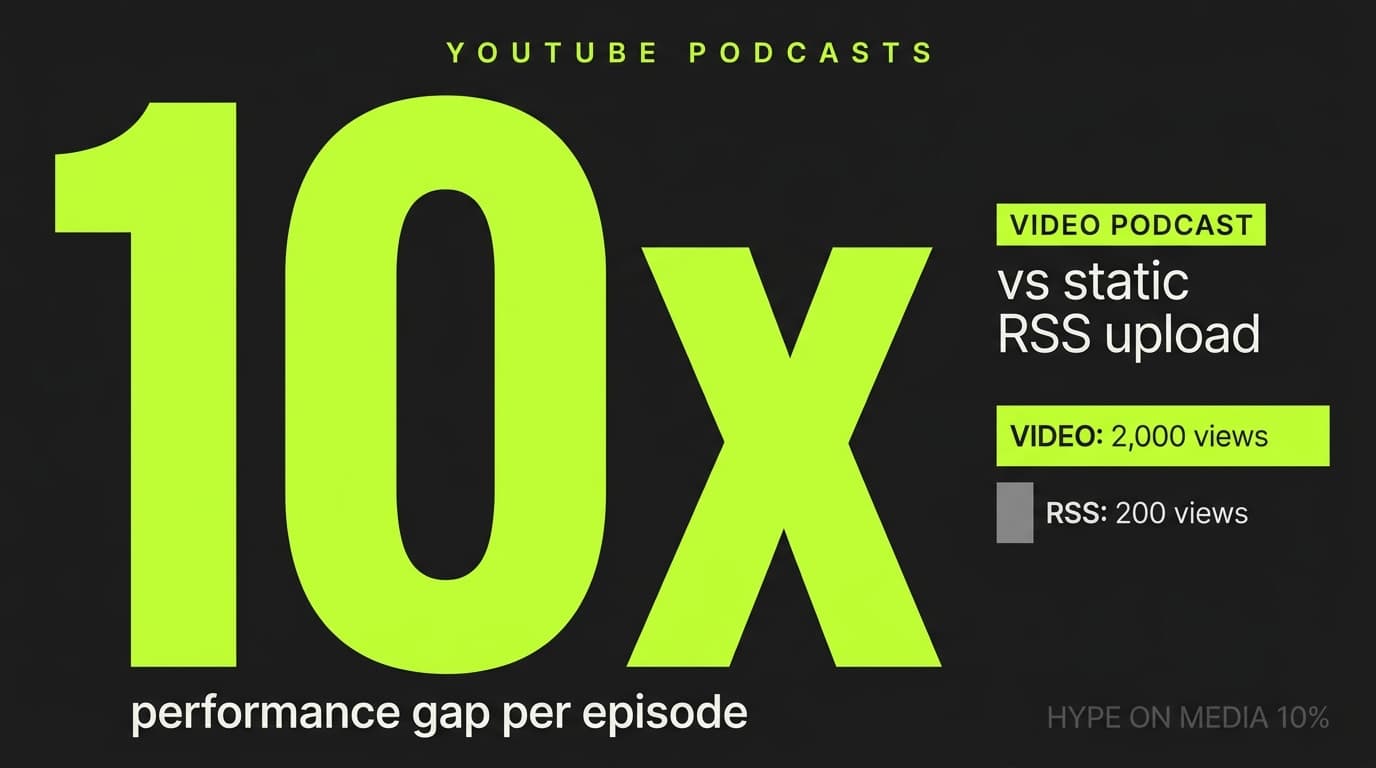
Our data across video podcast clients is direct: static-image podcast uploads — the format most RSS auto-publishes produce — averaged 200 views per episode in the 90 days following publication. Video-native podcast episodes with B-roll, visual hooks, and chapter markers on identical topics averaged over 2,000 views in the same window.
That is a 10x performance gap. And it compounds.
RSS integration is a useful tool. It is not a podcast strategy.
How YouTube RSS Integration Actually Works
Connect your RSS feed URL in YouTube Studio under the Podcasts section. YouTube validates the feed, maps episode metadata — title, description, publication date — to video fields, and starts auto-uploading new episodes within a few hours of RSS publication. Existing episodes can be bulk-imported.
For audio-only podcasts, YouTube generates a static image video using the podcast's cover art. For creators who already produce video content, the RSS upload can function as a distribution layer that bypasses manual upload workflows.
The distribution step is eliminated. For audio-first podcasters testing YouTube, it removes friction. For video podcasters, it can serve as a backup.
What RSS integration cannot do:
- Generate actual video from audio — static image covers are not video content in YouTube's quality assessment
- Add chapter markers or timestamp navigation — these require manual definition after upload
- Optimize titles and descriptions for YouTube search — RSS metadata is written for podcast app directories, not YouTube's search index
- Create the visual hooks, B-roll, and on-screen graphics that drive engagement and recommendation
- Signal production quality to the algorithm in ways that affect CPMs and suggested feed placement
The difference between treating RSS integration as a floor — the minimum viable YouTube presence — and treating it as a ceiling — the entire strategy — is the difference between 200 views and 2,000.
Why Video-Native Podcasts Dominate YouTube Discovery
YouTube is a video platform. Its recommendation algorithm evaluates content quality through signals that audio-with-static-image content structurally cannot produce.
A two-hour video of a single frozen image generates near-zero viewer interaction, chapter navigation, or visual engagement signals. The algorithm classifies it correctly: not YouTube-native content.
Video-native podcasts generate the full range of signals. Viewers pause on specific moments. They navigate chapters. They rewatch segments. They subscribe after seeing hosts they recognize. They share timestamps. Every one of these signals feeds YouTube's recommendation engine and determines whether the next episode surfaces to new viewers.
The discovery flywheel works like this: a viewer searches for a topic — not a podcast name, a specific question or subject. A video episode optimized for that query appears in results. The viewer watches a significant portion, subscribes to the channel, and is served future episodes via the subscription feed and Home recommendations. The audience is built through topical search, not subscriber notifications.
This flywheel does not activate for static-image audio content. RSS-published episodes appear in search only if their RSS-derived titles happen to match queries — and they generate minimal subscriber conversion because there is no visual identity to recognize or return to.
The production elements that create YouTube discovery advantage:
- Dynamic video: host on camera, B-roll illustrating topics discussed, or split-screen guest interviews
- Chapter markers: timestamped segments that enable navigation and generate chapter view data
- Visual hooks: opening sequences that communicate the episode's value proposition visually
- On-screen text callouts: key quotes and statistics as text overlays during the episode
- Episode-specific thumbnails: individual assets that work as cold-audience discovery pieces, not series covers
The Five-Element Production Formula
We produce video podcasts across B2B SaaS, financial services, professional services, and consumer categories. The formula we have refined across dozens of podcast launches has one consistent principle: every production decision is evaluated against YouTube discovery mechanics first, audio experience second.
Element 1: Search-first episode titles. RSS podcast titles are written for subscriber recognition — "Episode 147: The Future of Marketing with John Smith." YouTube titles are written for search — "Why 90% of B2B Marketing Budgets Are Wasted (Former Google CMO)." Same episode. Different title. Dramatically different discovery performance. Every episode title goes through YouTube autocomplete and keyword validation before publishing.
Element 2: Visual hooks in the first 60 seconds. YouTube measures viewer retention from the first second. Podcast intros — "welcome back to the show, today we have an amazing guest" — destroy retention on YouTube. Our podcast intros are hooks: the most compelling claim or insight from the episode, stated in the first 30 seconds, with the guest visible on screen. The interview begins after the hook, not before.
Element 3: Chapter architecture around insight peaks. We identify the five to seven most compelling segments during editing and structure chapter markers around them. Chapter names are written as insight summaries, not topic labels. "00:00 Why Most Companies Get LinkedIn Wrong" outperforms "00:00 LinkedIn Strategy Discussion" in both chapter click-through and rewatch rates.
Element 4: B-roll and visual callouts for key insights. When a guest states a compelling statistic or counterintuitive claim, it goes on screen as text. This creates pause-and-rewatch behavior — the highest-value engagement signal for YouTube's recommendation algorithm. B-roll that illustrates the concepts being discussed reduces viewer attention decay and extends average view duration.
Element 5: Episode-specific thumbnails, not series covers. Podcast series thumbnails — the same cover art on every episode — train the algorithm to treat your channel as a single repeating asset rather than distinct discoverable content. Episode-specific thumbnails that reflect the unique value of each conversation create individual search and suggested-feed assets. One client we work with saw a 340% increase in new subscriber acquisition after switching from series thumbnails to episode-specific thumbnails.
The Monetization Gap Is Larger Than It Looks
The performance gap between RSS-published static audio and video-native podcast content is not just a discovery gap. It is a monetization gap that compounds over time.
YouTube CPMs are determined by audience quality signals, content category, advertiser demand, and viewer engagement patterns. Audio-with-static-image content generates CPMs in the $1-3 range. Video-native podcast content with strong retention and chapter engagement earns $8-25 CPMs depending on category, because it attracts advertiser investment in high-attention viewing contexts.
For a podcast with 10,000 views per episode: $20-50 per episode for RSS uploads versus $80-250 per episode for video-native production. Over a 100-episode catalog, the difference exceeds $20,000 in direct advertising revenue — before accounting for sponsor integrations, which command higher rates on content that generates engagement data.
The compound effect is larger than the linear math suggests. Video-native podcasts that build subscriber audiences through YouTube discovery accelerate their own growth — more subscribers mean more initial views per episode, stronger recommendation signals, more new viewers, more subscribers. The flywheel turns. RSS-published content does not compound the same way because it generates minimal subscriber conversion from new viewers.
We have run this analysis for every podcast client considering RSS integration as their primary YouTube strategy. In every case, the 18-month return on video production investment has exceeded the incremental cost of production. The payback period is typically 6-9 months.
What Is Coming Next
YouTube's investment in podcast infrastructure — the Podcasts tab in 2023, RSS integration in 2024, ongoing improvements to podcast-specific search and recommendations — is not a feature sprint. It is a strategic commitment.
The next evolution, based on patterns visible in YouTube's product roadmap: podcast-specific search refinements where queries like "interviews with [person]" or "podcasts about [topic]" surface YouTube content more prominently, deeper integration between podcast episodes and YouTube's chapter and clip features, and potential podcast-specific monetization pathways separate from standard video ad revenue.
The creators who build video-native podcast infrastructure now will compound those advantages as YouTube's podcast investment deepens. RSS integration is a good tactical tool for distribution efficiency. It is not the foundation of a YouTube podcast strategy.
The window between "podcasting on YouTube" as a differentiator and "podcasting on YouTube" as table stakes is narrowing. The brands and creators who build proper video podcast systems in 2024 will own audience relationships that RSS-only competitors cannot replicate.
Frequently Asked Questions
How do I connect my RSS feed to YouTube?
In YouTube Studio, navigate to Settings → Channel → Advanced settings and look for the Podcast RSS feed option. Enter your RSS feed URL, verify ownership through the provided verification code, and YouTube will begin processing and uploading new episodes automatically. Existing episodes can be bulk-imported from the same interface. Note that YouTube's RSS upload creates static-image videos for audio-only podcasts — video production is required to capture YouTube's full discovery potential.
Will YouTube RSS integration hurt my audio podcast's download numbers?
In practice, YouTube video podcast views and traditional podcast downloads are distinct audiences with minimal overlap. Most podcast listening happens in audio-first contexts — commuting, exercising, background listening — while YouTube podcast viewing is a lean-forward, attention-forward context. Building a YouTube presence adds a new audience rather than cannibalizing existing listeners. Several podcast networks have reported that YouTube viewership additions increased overall cross-platform consumption by 15-25%.
What equipment do I need to produce a video podcast?
The production floor for effective YouTube video podcasts is lower than most creators expect. A single camera, basic three-point lighting, a quality microphone, and a clean background are sufficient to produce content that competes effectively on YouTube. The marginal improvements that matter most are editing quality — tightening the conversation, removing dead air — chapter architecture, and thumbnail design. Equipment upgrades are rarely the bottleneck.
How long should a YouTube video podcast episode be?
Our data shows YouTube podcast episodes in the 20-45 minute range generate the strongest subscriber conversion rates. Shorter than 20 minutes often does not feel like a full podcast experience. Longer than 60 minutes requires particularly strong editorial curation to maintain YouTube retention. The optimal length depends on format: interview episodes typically perform best at 25-40 minutes, educational formats at 15-30 minutes, and narrative formats at 30-60 minutes.
Does YouTube RSS integration affect SEO?
RSS-derived metadata is not optimized for YouTube search. Episode titles, descriptions, and tags from a podcast RSS feed are written for podcast app directories, not YouTube's search index. YouTube will index the uploaded content, but it will underperform against properly optimized uploads. For maximum search performance, edit the title, description, and add chapter markers manually after the RSS auto-upload creates the video. This hybrid approach captures the distribution efficiency of RSS while maintaining YouTube SEO quality.