The One-Person Orchestra Is Collapsing
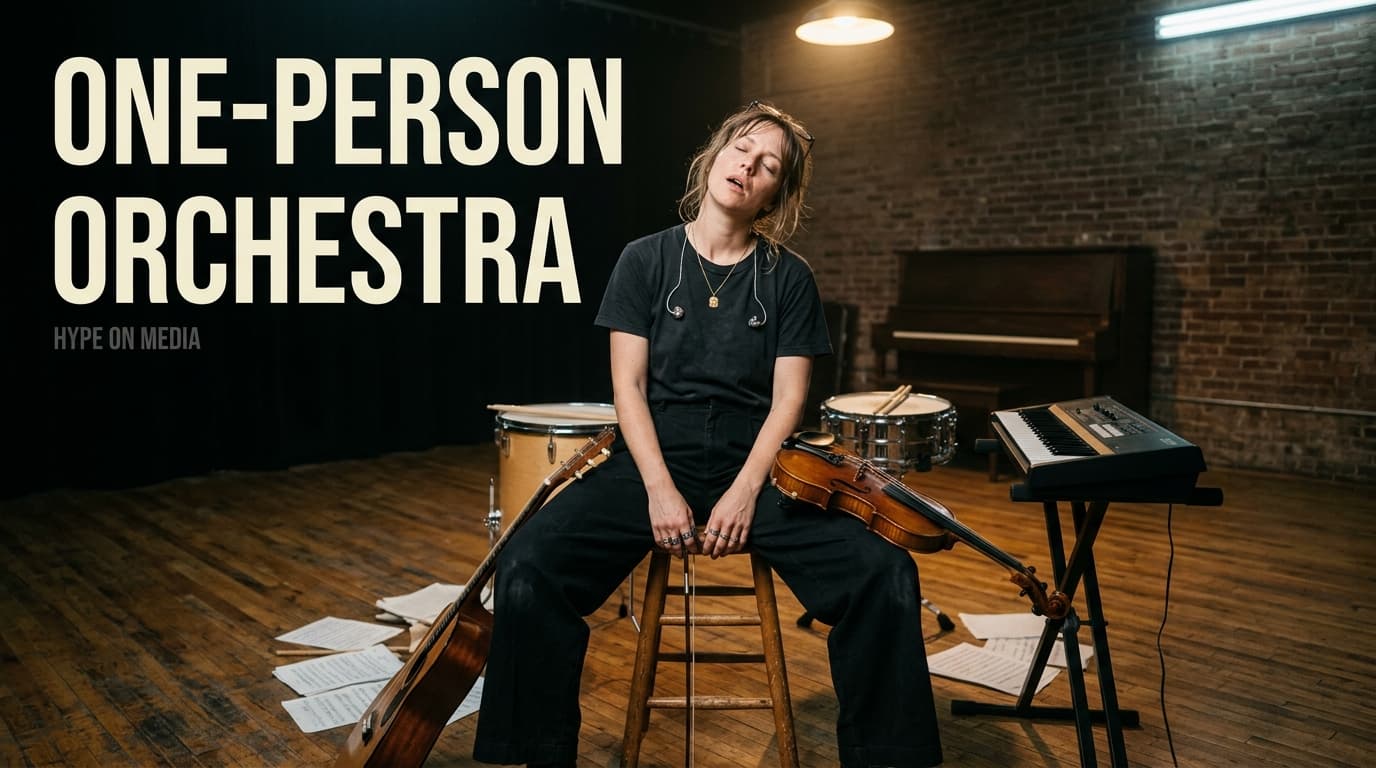
Picture a musician alone on stage at a concert hall. She is playing the violin with her right hand, hitting a kick drum with her left foot, leaning over to tap piano keys between bow strokes, and somehow trying to cue the lighting technician with a nod. The audience paid for a symphony. What they are hearing is chaos with moments of brilliance — a beautiful violin phrase interrupted by a missed beat, a piano chord that arrives two bars late, a performer visibly shaking from the effort of doing five jobs at once.
That is the creator economy in 2024.
The solo creator model asks one person to be the performer, the producer, the editor, the SEO strategist, the thumbnail designer, the community manager, and the business development lead — simultaneously, on a publishing schedule that never pauses. 79% of monetized creators report experiencing burnout. More than half have seriously considered quitting. These are not hobbyists who got bored. These are professionals who built real audiences and discovered that the operation required to sustain them is structurally impossible for one person to maintain.
The conventional advice — post less, batch content, practice self-care — is the equivalent of telling the one-person orchestra to play fewer instruments. It misses the point entirely. The solution is not fewer instruments. It is a full orchestra where the creator is the lead soloist and a production team handles the rest of the ensemble.
Why "Take a Break" Fails as a Strategy
The burnout conversation has been trapped in therapeutic language for years. Creators are told to set boundaries, manage their mental health, and find balance. This framing treats burnout as an individual failure rather than a structural one.
It is a structural one. The solo creator operating model demands that a single human being perform roles that, in every other media industry, are distributed across five to fifteen specialists. Television does not ask the anchor to also operate the camera, edit the footage, write the script, design the graphics, and negotiate the ad deals. Radio does not ask the host to also be the audio engineer, the program director, and the marketing department. Only YouTube asks one person to do everything — and then calls it "authenticity."
The therapeutic approach fails because the cause is not emotional. The cause is operational. A creator who takes a two-week vacation returns to the same structural problem: a job description that requires 40-60 hours per week of skilled labor across at least four distinct professional disciplines, all performed by one person. Rest does not fix a broken architecture. A redesigned architecture does.
The Four Instruments Nobody Can Play Simultaneously
Return to the orchestra. The solo creator is attempting to play four instruments at once, each demanding a different cognitive mode, a different skill set, and a different kind of energy. The result is not a symphony — it is a talented musician collapsing under impossible demands.
Instrument 1: The Performance. The role the audience sees — on camera, articulate, energetic, present. This role requires a specific mental state. You have to be "on." It takes preparation to get there and recovery time afterward. A concert violinist does not also tune every instrument in the orchestra before walking on stage. A creator should not be editing thumbnails twenty minutes before hitting record.
Instrument 2: The Strategy. Keyword research, content calendar planning, competitive analysis, trend identification, analytics review. This is analytical work — systematic, data-driven, forward-looking. It requires uninterrupted focus and a fundamentally different cognitive mode from performance. The conductor studies the score in a quiet room. The soloist rehearses in the practice hall. They do not do both at the same desk in the same hour.
Instrument 3: The Production. Scripting, shot planning, coordinating assets, managing the workflow from concept to raw footage. This is project management with a creative dimension. The orchestra's stage manager ensures the instruments are in position, the acoustics are tested, and the rehearsal schedule holds. The soloist never handles this.
Instrument 4: The Post-Production. Editing, color grading, audio mixing, thumbnail creation, SEO metadata, upload configuration, community replies. This is execution work — skilled, time-intensive, and deeply incompatible with the mental mode required for performance or strategy. In the orchestra, the recording engineer handles the mix. The graphic designer handles the concert poster. The publicist handles the press. One person cannot do all of this and also play a flawless solo.
Most solo creators cycle through all four instruments daily. The cognitive context-switching alone is exhausting before you account for the actual work. The burnout is not a personality problem. It is the predictable output of a structurally unsustainable job description.
The Full Orchestra Model: Creator as Lead Soloist
The production model that prevents burnout does what every other performance industry figured out decades ago: it separates the soloist from the ensemble. The creator's unique value — their voice, their perspective, their on-camera presence — is the solo violin. Everything else is the orchestra.
The Soloist (Creator): 3-6 hours per week. The creator films, provides the authentic voice, makes high-level editorial decisions ("this topic, this angle, this tone"), and approves the final output. This is the role that requires the creator's specific personality, face, and perspective. Nothing else does.
The Ensemble (Production Team): Everything else. Research, scripting, editing, thumbnail design, SEO metadata, scheduling, community management. These are the instruments that most creators learned to play out of necessity — not because they are uniquely suited to play them, but because nobody else was on stage. A skilled production team executes these functions faster and at higher quality than a creator who is simultaneously trying to perform.
The Conductor (Analytics and Strategy): Monthly input. Performance review, channel-level strategy adjustments, content calendar optimization. This requires the creator's input but not their constant attention. Monthly strategic reviews replace the daily analytics anxiety that consumes solo creators.
The result is a channel that operates at professional publishing standards — consistent schedule, optimized for discovery, visually coherent — while requiring 3-6 hours per week of the creator's time rather than 40-60. The music improves because the soloist is not also playing the drums.
What Happens When the Soloist Stops Playing the Drums
The most common objection to the full orchestra model is authenticity. Creators worry that bringing in a team will dilute the quality that made their channel distinctive — the specific way they explain things, the humor, the voice.
This concern has a specific answer: the creator's voice lives in the performance, not in the post-production.
What makes a channel distinctive is the creator's on-camera presence. The perspective they bring. The way they explain ideas. Their relationship with the audience. None of that lives in the edit. A production team editing your footage does not change what you said or how you said it. They shape the pacing, the visuals, the structure — but the substance is entirely yours. The violinist's interpretation of Beethoven does not change because a different sound engineer mixed the recording.
In practice, production-supported creators often improve their performance quality. When a creator is not also responsible for editing, SEO, and thumbnail design, they arrive for filming with more mental bandwidth. They are less fatigued. The performance is better. The solo violinist who does not have to worry about the timpani sounds better, not worse.
Across our portfolio at Hype On, production-supported channels maintain audience retention rates within 5% of the same creators' solo-produced work. In many cases, retention improves — because the production team brings editing discipline that the fatigued solo creator was too exhausted to apply consistently.
Building the Orchestra Without Losing the Sound
The practical implementation of a production system requires what we call a voice document — the equivalent of an orchestral score that tells the ensemble exactly how the music should sound.
Before a production team can execute effectively, they need to understand what makes the channel distinctive. This means documenting the channel's tone, the kinds of topics it covers and explicitly avoids, the specific phrases and vocabulary the creator uses, the energy level and pace of the editing, the thumbnail aesthetic, the types of hooks that resonate with the audience.
With this documentation in place, a skilled editor can cut footage to match the channel's established rhythm. A scriptwriter can draft outlines that sound like the creator. A thumbnail designer can work within the visual language without starting from scratch every video. The score tells every musician how to play — and the music sounds like it was always meant to sound this way.
The first production cycle is an investment in calibration. The first rehearsal with a new orchestra is never the concert. By the third or fourth video, the team's output requires minimal revision. By the tenth, the workflow runs on minimal back-and-forth. This is the ramp-up curve we have refined across dozens of channel launches and transitions at Hype On. The calibration investment at the start pays back over every video that follows.
The Prediction That Came True
We predicted in early 2024 that the burnout epidemic would accelerate the shift toward production partnerships. By 2025, creator-agency partnerships grew 40% year over year — the fastest-growing segment of creator economy services.
The prediction was not difficult to make. The underlying economics were clear: creators who attempt to do everything themselves hit a ceiling defined by their personal working capacity. Creators who build production systems have no ceiling defined by individual output. The difference in growth trajectories compounds over time.
The burnout model is the cost structure of building a career on a foundation that cannot scale. The production model is the cost structure of building a business.
The creators who made the transition early — who stopped trying to play every instrument and instead invested in building a full orchestra — are now the ones still publishing, still growing, and looking back at the burnout years as a problem they solved rather than a condition they manage. The one-person orchestra was never sustainable. The full ensemble is.
Frequently Asked Questions
Why are so many YouTube creators experiencing burnout?
Creator burnout is primarily structural, not personal. The solo creator model requires one person to simultaneously perform the roles of on-camera talent, producer, editor, SEO specialist, thumbnail designer, and community manager — while maintaining publishing frequency. This is the equivalent of asking one musician to play every instrument in an orchestra simultaneously. The cognitive load of continuous role-switching, combined with escalating output demands, produces burnout predictably. 79% of monetized creators report experiencing it.
What does a sustainable creator production model look like?
A sustainable model separates the creator's role (performance, editorial direction) from production execution (research, scripting, editing, thumbnails, SEO, publishing). The creator functions as the lead soloist — 3-6 hours of work per week — while a dedicated production team handles the ensemble. The channel operates at professional standards without the operational burden falling on a single person.
Will content quality suffer if I bring in a production team?
No — provided the team is briefed through a voice document that captures your channel's tone, vocabulary, editing pace, and visual identity. A creator's voice lives in the on-camera performance, not in the post-production. A production team editing your footage preserves what makes your channel distinctive while improving consistency, pacing, and optimization. Our data shows production-supported channels maintain audience retention within 5% of solo-produced baselines, with many improving.
How do I document my "voice" for a production team?
A voice document should include: channel tone and vocabulary, content categories the channel covers and explicitly avoids, thumbnail aesthetic and design system, editing pace and style benchmarks, hook formats that have historically performed well, and the creator's specific communication patterns. Think of it as the orchestral score — it tells every team member how the music should sound without the creator directing every note in real time.
How long does it take for a new production team to match my channel's quality?
The calibration curve is typically 3-5 videos. The first video requires the most revision and feedback — the first rehearsal with a new orchestra is never the concert. By the third or fourth video, the team understands the channel's patterns and requires significantly less direction. By the tenth video, the workflow runs with minimal creator input. The upfront calibration investment pays back over every subsequent video produced.