The Dining Room Just Merged With the Takeout Counter
For two years, YouTube kept Shorts and long-form videos in separate rooms. The Shorts shelf. The dedicated tab. Two distinct content types with two distinct audiences and two distinct visual languages. That wall is coming down.
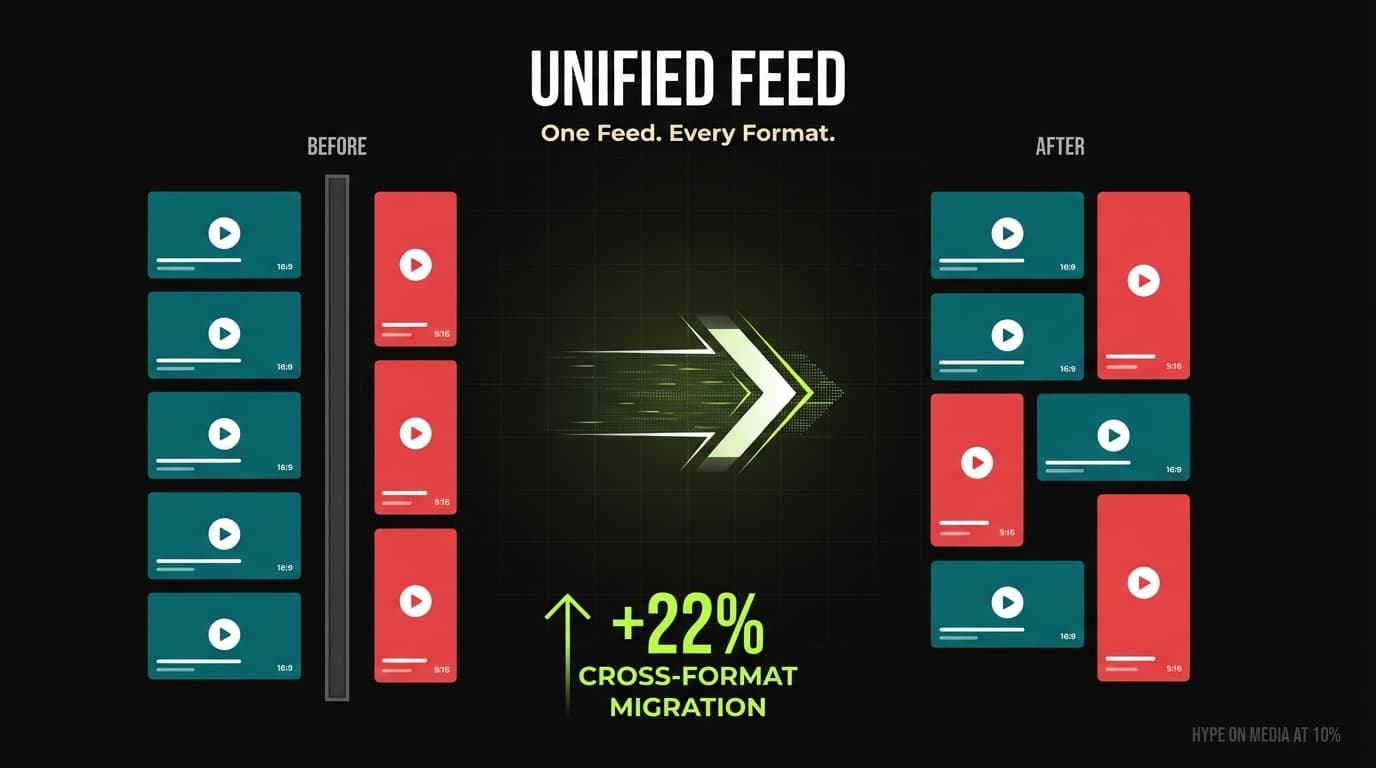
A unified feed is like a restaurant that just knocked down the wall between the dining room and the takeout counter — every dish is visible to every customer, so the $12 takeout box sitting next to the $45 plated entree either elevates or embarrasses the kitchen. In August 2024, YouTube began testing exactly this: a single scrollable home feed where Shorts appear inline between long-form video cards. The Shorts swipe-up feed still exists, but in the test group, the main feed no longer distinguishes between formats.
This is not a minor UI tweak. It is an architectural shift that changes how viewers encounter content, how the algorithm evaluates format signals, and — critically — whether your Shorts and long-form content are building the same brand or undermining each other. The channels that have been running Shorts as a disconnected operation are about to discover the cost.
What the Unified Feed Actually Changes
The mechanics sound simple — Shorts appear in the main feed. The implications are layered and compounding.
Viewer context shifts dramatically. In the dedicated Shorts feed, viewers have already opted into rapid consumption. They are swiping. The hook requirements are built for that speed. When a Short appears in the main feed — between long-form cards — the viewer is in a different mode entirely. They are browsing, evaluating, deciding. The interaction model is scroll, not swipe. A Short optimized for one-second pattern interrupts may actually underperform in the unified feed where the viewer's thumb is making slower, more deliberate decisions.
Visual identity becomes cross-format currency. In the unified feed, your Shorts thumbnail (or first frame) appears directly adjacent to your long-form thumbnails. If there is no visual consistency — if your Shorts look like a completely different channel than your long-form — viewers who engaged with one format will not recognize the other. This is where visual identity stops being a design preference and becomes a measurable growth lever.
Algorithm cross-format signals accelerate. YouTube's recommendation engine already tracks behavior across formats. The unified feed creates direct spatial adjacency — a viewer engaging with your Short and your long-form video in the same scroll session gives the algorithm a much stronger co-engagement signal than separate format interactions ever could. Channels that give the algorithm consistent visual and topical signals across formats see recommendations compound faster.
The Restaurant Problem: Two Kitchens, One Brand
Extend the analogy. Most YouTube channels operate like a restaurant running two separate kitchens — one for dine-in, one for takeout — with different chefs, different plating standards, and different quality expectations. When those kitchens served different customer lines, the disconnect was invisible. Now every customer sees both.
Long-form content evolved its visual language over a decade. Thumbnails are horizontal, text-heavy or face-forward, designed for 16:9 comparison in search results and suggested videos. Shorts developed an entirely different aesthetic — vertical, motion-driven, text-minimal, optimized for the first frame.
Many channels run these as two separate content operations. The long-form team creates thumbnails with one aesthetic. The Shorts editor handles vertical cuts with a different visual approach. The result is a channel that looks fractured — two different brands sharing one URL.
In a world where those formats live in separate experiences, the disconnection is tolerable. In a unified feed, it becomes a competitive disadvantage. Viewers who encounter a Short from your channel and then scroll to see a long-form thumbnail from the same channel should recognize the relationship instantly. If they cannot, you have failed to build an identity that compounds across the algorithm's discovery surfaces.
At Hype On, we build channel design systems that explicitly govern thumbnail aesthetics, Shorts cover frames, channel art, and lower-third treatments across both formats. We started this in early 2024, when the signals about format convergence were still speculative. The unified feed test confirms the direction was right.
What Needs to Change in Your Shorts Production
If the unified feed becomes the default — and the test trajectory suggests it will — several Shorts production elements need to adapt immediately.
The first frame must function as a thumbnail. In the dedicated Shorts feed, the first frame is a small vertical preview. In the unified feed, it appears in context alongside long-form thumbnail cards. The first frame must carry the visual weight of a thumbnail — brand color, recognizable face or graphic, readable text if text is present. A blurry action shot that works as a swipe trigger does not work as a scroll-stop.
Shorts need clearer topic signals. Long-form thumbnails invest significant real estate in communicating the video's topic or benefit. Many Shorts lead with aesthetic motion that looks interesting but communicates nothing specific. In the unified feed, Shorts that do not communicate their topic in the first frame will be scroll-past content — dismissed before the viewer even registers the channel name.
Cross-promotion becomes implicit. When Shorts and long-form appear in the same feed, viewers form impressions of the entire channel from both formats simultaneously. A weak Short alongside a strong long-form creates cognitive dissonance. Your channel's impression is now the sum of everything a viewer encounters in a single feed session — not just the format they choose to engage with.
The Channels That Benefit Most — And the 22% Advantage
The unified feed is not uniformly negative. For channels that have already built cross-format visual coherence and audience continuity, it functions as an accelerant.
Channels with consistent visual identities across formats see faster subscriber conversion when a Shorts viewer encounters long-form content for the first time. The recognition triggers trust. The viewer who watches a Short and then sees a long-form thumbnail with the same visual language, the same creator face, the same color palette — that viewer makes a faster decision to explore.
Our data across managed channels shows 22% higher cross-format viewer migration for channels with explicit cross-format identity systems versus channels where formats are visually siloed. In a unified feed, that advantage compounds — the algorithm's ability to predict cross-format interest is stronger when the channel provides consistent signals.
The channels most disrupted are those that built Shorts as a separate product line — optimized for Shorts-specific metrics while being entirely misaligned with the visual expectations a long-form viewer holds. Their Shorts may have been excellent by Shorts metrics. In the unified feed, those same Shorts become brand liabilities.
What We Predicted — And What the Data Shows Now
We began advising clients to invest in cross-format visual identity systems in early 2024, before the unified feed test was public. The hypothesis: channels with coherent design language across short and long formats would outperform as the platform blurred format boundaries.
The unified feed test confirmed the trajectory. By 2025, channels in our portfolio with explicit cross-format design systems are showing measurably higher home-feed click-through rates — the metric that reflects how well a channel converts impressions in the main feed across all content types.
The channels that separated their Shorts and long-form operations are now retroactively building the visual bridges that should have been there from the start. Retroactive is always more expensive. The restaurant that waited to train its takeout kitchen in plating standards is now losing dine-in customers who saw the takeout boxes first.
Whether you build this in-house or work with a team like ours, the framework is the same: one visual identity system, two format executions, zero brand disconnect. The unified feed is not a test you can ignore — it is the direction YouTube is moving.
Frequently Asked Questions
What is YouTube's unified feed test?
YouTube began testing a unified home feed in August 2024 that mixes Shorts and long-form videos in a single scrollable experience. Instead of Shorts being exclusively accessible through the dedicated Shorts shelf and tab, they appear inline within the main home feed alongside long-form content cards. The change affects how viewers discover content and how the algorithm connects behavior across formats.
Will the unified feed replace the dedicated Shorts shelf?
The dedicated Shorts experience is unlikely to disappear — it serves a distinct consumption behavior (rapid swipe-through browsing) that the main feed does not replicate. The unified feed appears to be about expanding Shorts distribution surfaces, not eliminating the format-specific experience. Both surfaces will likely coexist, with the algorithm determining which context each piece of content appears in.
How should I change my Shorts production for the unified feed?
Focus on three changes: (1) ensure your Shorts' first frames function as thumbnails — communicating topic and brand identity visually, not just aesthetically; (2) build visual consistency between your Shorts cover frames and long-form thumbnails so viewers recognize the channel across both formats; (3) include clear topic signals in the first frame so unified-feed browsers can evaluate the Short without tapping.
Does the unified feed affect how the algorithm recommends Shorts?
Yes. The unified feed creates stronger co-engagement signals — when viewers engage with Shorts and long-form in the same feed session, the algorithm calibrates cross-format recommendations more efficiently. Channels with strong cross-format visual identity and topic consistency see faster cross-format recommendation expansion as a result.
What channels are hurt most by the unified feed change?
Channels that built Shorts as a completely separate content operation — with different visual language, different topics, and no audience overlap with their long-form content — face the greatest adjustment. When these Shorts appear in the main feed alongside the channel's long-form thumbnails, the visual disconnection confuses both viewers and the algorithm, reducing cross-format discovery.