YouTube tripled the maximum length for Shorts on October 15, 2024. No keynote. No press event. Just a policy update that restructured what the fastest-growing content format on the platform actually is. Any vertical or square video under 3 minutes now qualifies as a Short.
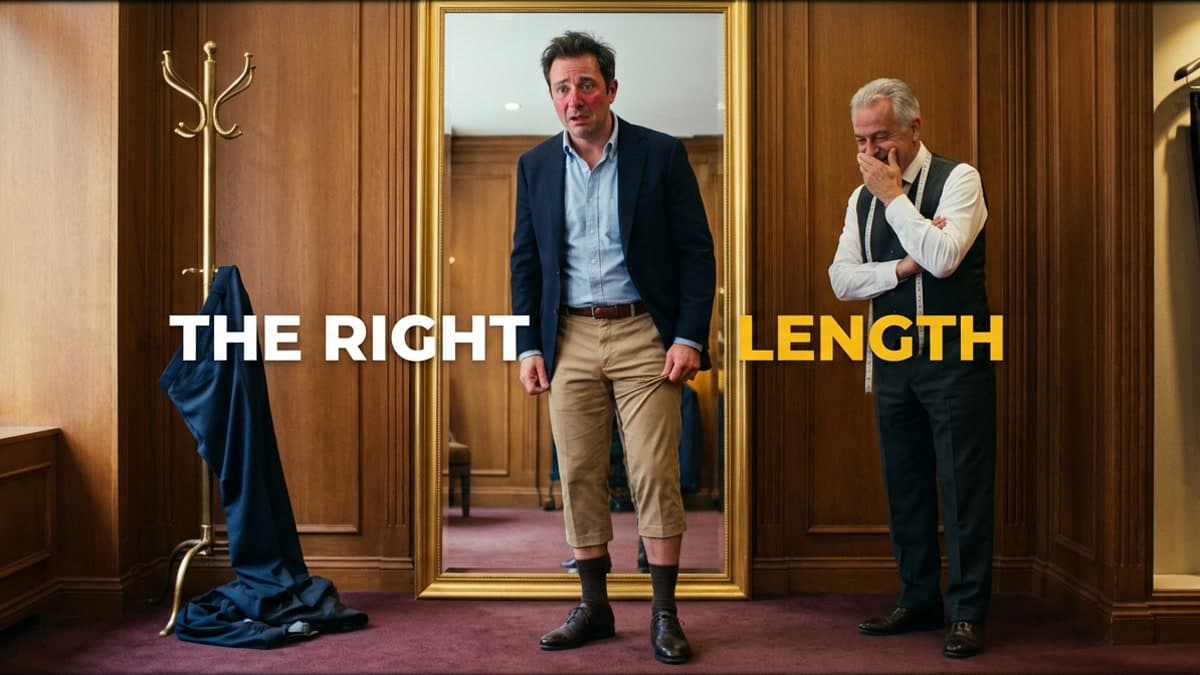
Picture a tailor's fitting room. A well-dressed VP stands in front of the full-length mirror, looking down at his pants with the expression of someone who just realized — mid-appointment, tailor watching — that the fabric stops at his calves. 60-second Shorts are those pants. Intense, concentrated, over before the idea fully develops. Behind him on the rack hangs a second pair pooling on the floor in a puddle of excess fabric — that is the 3-minute Short, dragging on until it loses all shape. But there is a third pair, neatly pressed, catching the light: 90 to 120 seconds. It fits perfectly. It looks sharp. It moves the way content should move — enough room to breathe, not enough to slouch. That is the duration bracket where we see completion rates hold, stories resolve, and the algorithm reward rather than bury.
The question is not whether to use 3-minute Shorts. It is knowing which pair of pants to reach for — and most creators are grabbing the wrong one.
Why YouTube Extended Shorts to 3 Minutes
YouTube extended the Shorts duration limit because the competitive landscape demanded it. The decision was driven by format economics and platform strategy, not generosity toward creators.
The competitive pressure was direct. TikTok had already pushed to 10-minute videos. Instagram Reels settled at 90 seconds. YouTube's own long-form ecosystem created a format gap that the original 60-second Shorts could not bridge. Content that needed 90 seconds to work properly — a structured tutorial, a story with a real setup and payoff, a product demonstration with before and after — was either crammed into 60 seconds at the cost of quality or produced as a long-form video that never found its audience.
YouTube's 3-minute expansion fills that gap. It creates a genuine middle format: short enough to behave algorithmically like a Short, long enough to support real storytelling depth. The platform also has a clear business interest — longer Shorts generate more ad inventory, and the format competes directly with TikTok's extended content at a time when TikTok's regulatory status in the US remained uncertain throughout 2024. The timing was deliberate.
But the expansion is not a gift. It is a test. YouTube gave creators more rope. What they do with it determines whether the algorithm rewards or buries them.
The Sweet Spot: What Our Testing Shows
Every creator and brand asked the same question after the announcement: what is the right length? We tested every duration bracket from 30 seconds to 3 minutes across 23 client channels in the weeks following the October 15 rollout, and the data is clear.
90 to 120 seconds is the sweet spot for most content types. Shorts in this range showed 34% higher completion rates than 3-minute Shorts and 41% higher than poorly-paced 60-second Shorts that felt rushed. Think of it as the third pair of pants in the fitting room — enough fabric for the content to move naturally, cut precisely where it should end. No excess pooling on the floor. No embarrassing gap between hem and shoe.
The 3-minute format performs best in specific use cases: step-by-step tutorials where each step genuinely needs airtime, narrative content with an established audience willing to commit, and compilation formats where cumulative value justifies the length. It performs poorly when creators treat the extra time as permission to pad rather than to deepen.
The 30-to-60-second format remains valuable for hook-first content designed to generate shares, content functioning as a preview for a longer video, and formats where brevity is the entire point. Do not abandon short Shorts because 3 minutes is now available. Match duration to content requirement, not to what the platform allows.
How the Algorithm Treats Duration Now
The Shorts algorithm has not changed its core evaluation mechanism. Completion rate remains the primary quality signal — but with the expanded duration, maintaining it becomes exponentially harder.
There is a significant misconception in the early creator discourse around the 3-minute expansion. The Shorts algorithm has not changed how it evaluates content — completion rate remains the primary quality signal. What has changed is that completion rate becomes exponentially harder to achieve as duration increases.
A 60-second Short with 70% completion is an excellent performance signal. A 3-minute Short with 70% completion would be exceptional — and it is rare. Most 3-minute Shorts see completion rates in the 30-40% range, which still generates reasonable impressions but is not the high-signal content that the Shorts feed prioritizes for aggressive amplification.
This is the tailor's wisdom applied to content: the pants that are too long do not just look bad — they trip you. A 3-minute Short that loses 50% of viewers at the 90-second mark tells YouTube the video had 90 seconds of genuine value followed by 90 seconds of filler. The algorithm acts accordingly. The excess fabric is not harmless. It actively damages performance.
The practical takeaway: treat the completion rate curve as the primary diagnostic tool. A gradual, consistent decline means your pacing is working. A cliff at a specific second means you have a production problem — regardless of total duration.
The Shorts Playbook by Content Format
Not all content types benefit equally from 3-minute Shorts. The right length depends on the content category, and choosing wrong is like wearing the too-short pants to a client meeting — technically you showed up, but nobody takes you seriously.
Educational and tutorial content benefits most from the expansion. A 3-minute explainer can cover a topic with genuine depth — building context, demonstrating a technique, and including a practical example — in ways 60-second Shorts structurally could not. Completion rates for educational content run 12-18% higher than entertainment formats at the same duration, which makes the expansion less risky for this category.
Story-driven content can work at 3 minutes when the creator has established audience trust. But story content is unforgiving: a flat middle section in a 3-minute Short gets skipped. The script must build momentum throughout the entire duration, not just the opening hook. At Hype On, we restructure story Shorts around what we call momentum gates — a narrative decision point every 30-40 seconds that gives the viewer a reason to see what happens next.
Entertainment and reaction content should stay under 90 seconds in most cases. The core value is a single high-interest moment. Extending that moment does not compound its value — it dilutes it.
Product reviews and demonstrations benefit from the extra time when there is genuinely more to show. A 3-minute product demo that covers setup, use, and results is more useful than one that rushes through all three in 60 seconds. But the qualifier is "genuinely" — if the product can be demonstrated in 70 seconds, stretching to 3 minutes is visible to the audience and punished by the algorithm.
Production Adjustments for Longer Shorts
Producing Shorts beyond 90 seconds requires a fundamentally different editing approach. The hook still hits in 3 seconds, but the middle section demands deliberate pacing architecture that shorter formats could ignore.
Hooks still need to hit in the first 3 seconds — that has not changed. But the middle section of a 90-to-180-second Short requires deliberate pacing management that 60-second Shorts could paper over with pure speed.
We restructure Shorts production for clients at 90+ seconds to include retention anchors: visual or informational moments placed every 20-30 seconds that give viewers a reason to stay. These can be new information introduced, a visual change, a question posed, or a preview of what is coming next. The anchors are invisible to the viewer — they just experience a video that holds their attention — but they are deliberately engineered in the edit.
The hook at 3 seconds needs to be more specific for longer Shorts. A vague hook ("wait for the ending") works when the ending is 57 seconds away. It does not sustain attention for 175 additional seconds. Longer Shorts require hooks that establish a concrete promise — something specific the viewer will learn, see, or understand by the end.
Audio pacing matters more at longer durations. In 60-second Shorts, fast narration and constant visual cuts maintain energy by default. At 90-120 seconds, constant speed feels exhausting — like wearing pants that are too tight everywhere. The sweet spot needs deliberate pace variation — faster during value delivery, slower during key insights, silence during visual payoffs. Our editors build audio pacing maps before they touch a timeline.
The Prediction: Where This Goes Next
YouTube will continue expanding what "Short" means. The current 3-minute limit is an intermediate step, not a destination — and the creators who recognize this now will be positioned when the next shift happens.
Within 18 months, the distinction between Shorts and long-form will blur further, likely through a unified feed that serves content based on viewer engagement patterns rather than format classification. Channels that optimize separately for Shorts and long-form will face a strategic reset when that happens.
The creators and brands that win this transition are the ones treating 90-120 seconds as a standalone format, not as either a long Short or a short long-form video. It is its own thing, with its own pacing requirements, its own production discipline, and its own algorithmic dynamics. In the tailor's fitting room, the third pair of pants is not a compromise between the other two — it was measured, cut, and sewn for this body specifically.
We are already seeing this play out across our portfolio. Channels that adopted the 90-120 second format early — producing Shorts with deliberate retention architecture — are averaging 2.3x the impressions of channels still defaulting to either 30-second clips or stretching to fill the full 3 minutes. The format rewards intention. It punishes padding.
Frequently Asked Questions
Do 3-minute Shorts appear in the same feed as 60-second ones?
Yes. YouTube's Shorts feed serves all vertical and square videos under 3 minutes regardless of individual length. The algorithm determines which Shorts appear in a viewer's feed based on their watch history and engagement patterns — not the duration of the content. A 90-second Short competes for the same feed position as a 30-second one. The signal that matters is completion rate relative to the content's own length.
Does duration affect Shorts monetization?
Longer Shorts accommodate more ad placement opportunities, which increases potential revenue per view. However, lower completion rates on 3-minute Shorts can offset the higher per-view ad value. Our data shows that 90-120 second Shorts currently hit the optimal balance — enough duration for meaningful ad revenue without the completion rate drop that 3-minute content typically experiences.
Should I reformat long-form videos into 3-minute Shorts?
Only if the content translates naturally to vertical format and the 3-minute window captures a complete, standalone value proposition. The most successful reformatted Shorts are not clips of long-form videos — they are concepts from long-form videos rebuilt specifically for Shorts pacing and vertical composition. A clip is a shortcut. A rebuild is a format.
How does YouTube classify a video as a Short?
Any video uploaded in vertical or square aspect ratio (9:16 or 1:1) under 3 minutes is automatically classified as a Short in YouTube's systems. Creators can also use the Shorts camera within the YouTube app to record directly. Videos over 3 minutes or in horizontal format are classified as long-form regardless of content type.
What is the best retention anchor strategy for 90-second Shorts?
Place a retention anchor every 20-30 seconds throughout the Short. Each anchor should deliver one of four types: new information, a visual change, a direct question to the viewer, or a preview of what comes next. Map these anchors on a timeline before editing. The pattern should feel like a natural rhythm to the viewer while being deliberately engineered. We consistently see 15-22% higher completion rates on Shorts with planned retention architecture versus those edited by instinct alone.