Two Rivers, One Strategy
Think of YouTube monetization as two rivers. Long-form is a narrow, deep channel — concentrated audience, rich revenue per view, $3 to $15+ RPM depending on niche. Shorts is a wide, shallow river — massive reach, millions of views flowing fast, but thin revenue per gallon. For most of 2023, that shallow river barely covered production costs.
What changed in 2024 is that the rivers started converging. Shorts monetization is like a wide, shallow river flowing toward the deep channel of long-form revenue — the creators building at the confluence, where reach meets depth, are the ones capturing value from both currents. YouTube confirmed as much in July 2024: the company announced it is "closing the gap" between Shorts and long-form monetization. And the numbers back the language.
The question is no longer whether Shorts can generate revenue. It is whether your content strategy is built at the confluence — or still treating these as two separate waterways.
Where Shorts RPM Started (And Why Creators Laughed)
The Shorts Fund model that YouTube ran through 2022 was a discretionary bonus pool, not a monetization system. A creator with 10 million Shorts views might receive $500. Another might receive $1,200 for similar numbers. The payouts had no relationship to advertising economics — they were essentially thank-you notes from the platform.
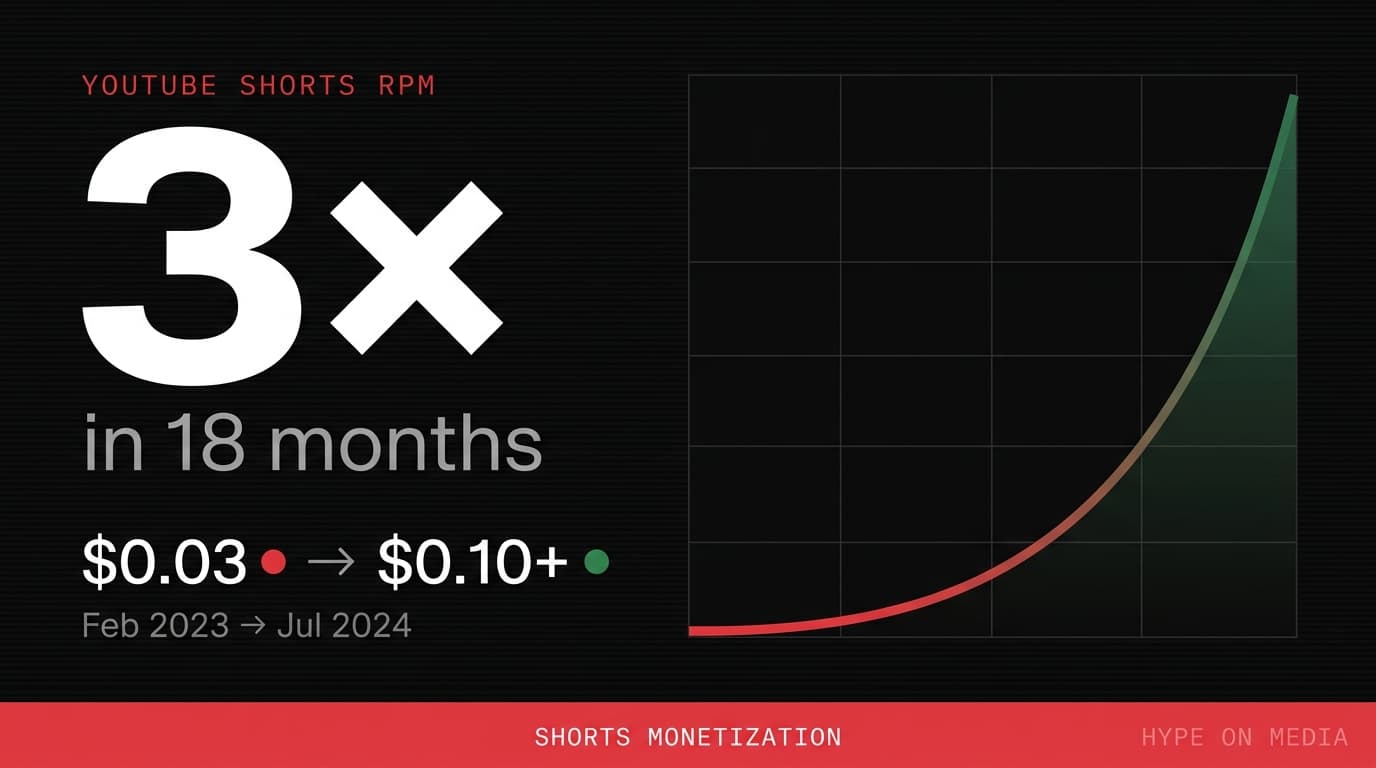
When YouTube switched to the 45% revenue-sharing model in February 2023, the theoretical framework improved. Creators began earning a share of actual ad revenue. But advertiser demand for Shorts inventory was thin. Ad loads were limited. CPMs were basement-level. The result: RPMs hovering between $0.03 and $0.06 per thousand views for most channels.
For context, typical long-form RPMs in competitive niches sat between $3 and $15+ at the same time. The "gap" was not a gap — it was a canyon. A 5-million-view Short might generate less than $50. The same views on a long-form video in the finance niche would generate $15,000 or more.
Creators were right to laugh. But the trajectory was already forming.
The July 2024 Inflection Point
By April 2024, Shorts RPMs had climbed above $0.10 per thousand views on YouTube's own disclosure. YouTube confirmed in July 2024 that Shorts RPM had tripled over the previous 18 months. The "closing the gap" language was not marketing — it reflected structural improvement in how the platform monetizes vertical content.
The mechanism is straightforward: advertiser adoption. Shorts ad formats — particularly full-screen, sound-on vertical video — proved measurably effective for direct response campaigns targeting mobile-first audiences. As more advertisers competed for that inventory, CPMs rose. As CPMs rose, the 45% creator share translated into meaningful RPM improvement.
In several high-CPM niches — personal finance, business, technology — Hype On clients were seeing Shorts RPMs between $0.12 and $0.18 per thousand views by mid-2024. Still dramatically below long-form. But no longer a joke.
The Real Numbers: RPM by Niche
Across our portfolio of channels in mid-2024, Shorts RPM distribution breaks into three tiers that matter for production decisions:
Low RPM Shorts (under $0.08): Entertainment, gaming, memes, general comedy. These categories generate Shorts views cheaply — virality is easier — but advertiser demand is weak. At $0.05 RPM, a Short with 1 million views generates $50. Revenue is incidental, not strategic. Shorts here are pure discovery plays.
Mid RPM Shorts ($0.08 to $0.15): Lifestyle, fitness, food, general business content. The majority of professionally produced channels fall here. At this range, a 1-million-view Short generates $80 to $150. Still not long-form economics, but at scale — if you are producing 15 to 20 Shorts per month — the cumulative revenue starts justifying dedicated production time.
High RPM Shorts ($0.15 to $0.30+): Finance, SaaS, career, B2B-adjacent content. These niches carry the highest advertiser demand on the platform in any format. Shorts in these categories now approach 5 to 10% of long-form RPMs in the same niche. That ratio changes the production calculus considerably. A channel producing 20 high-RPM Shorts monthly alongside 4 long-form videos is now capturing revenue from both rivers simultaneously.
The data point that matters most: finance Shorts earn roughly 10x higher RPM than comedy or lifestyle content. Niche selection is not a creative preference — it is a revenue architecture decision.
The Hybrid Model: Building at the Confluence
Improved Shorts monetization does not displace long-form. The economics remain fundamentally different, and the audiences served by each format are distinct. Long-form builds the relationship that converts viewers into subscribers, community members, and buyers. Long-form watch time is still the primary driver of algorithmic recommendation trust.
What Shorts enable is discovery at a scale and cost that long-form cannot match. A Shorts video costs a fraction of a long-form video to produce and reaches audiences who have never encountered the channel. When those viewers migrate to long-form, the economics shift entirely.
Here is where the confluence analogy becomes a production model. Hype On's hybrid framework builds this explicitly:
Shorts = acquisition channel. Wide reach, low cost per impression, new audience discovery. Direct revenue is a bonus, not the primary objective — though it is increasingly meaningful.
Long-form = retention and monetization channel. Deep engagement, high RPM, subscriber conversion, community building. This is where the revenue math lives.
The bridge: Every long-form video contains natural 30 to 90 second segments that perform as Shorts — the most striking claim, the key insight stated plainly, the demonstration moment, the surprising reveal. Extracting these is not clip-cutting. It requires understanding what hooks in vertical format. But the production cost is less than 15% of the base video cost.
Channels in our portfolio that implement this hybrid model generate 60 to 80% more total channel views than comparable long-form-only channels. With Shorts RPMs tripling in 18 months, that view difference is translating into revenue difference at an accelerating rate.
The Production Math: What Hybrid Actually Costs
For channels currently producing only long-form, the question is not whether to add Shorts — it is how to add them without compromising long-form quality. The math breaks down simply:
Dedicated Shorts production (filming original Shorts from scratch): high cost, unpredictable ROI, competes for the same production hours as long-form. Not recommended as a starting strategy.
Extraction model (pulling Shorts from existing long-form): 3 to 5 Shorts per long-form video, each optimized for vertical format with appropriate hooks and pacing. Additional cost is under 15% of the base video budget. This is where Hype On starts every hybrid engagement.
At scale, a channel producing 4 long-form videos per month generates 12 to 20 Shorts from the same content. If those Shorts average 500,000 views each at $0.12 RPM, the Shorts alone contribute $600 to $1,200 monthly in direct revenue. That is before counting the subscriber pipeline they feed into long-form.
The channels that invested in this model in 2023, when Shorts revenue was negligible, now have 18 months of performance data telling them exactly what hooks, lengths, and formats work in their niche. That institutional knowledge compounds. The channels that ignored Shorts until 2024 are running experiments their competitors already finished.
What We Predicted — And Where the Numbers Landed
We built our hybrid strategy model in 2023 on one assumption: Shorts RPM would keep improving as advertiser adoption grew. The July 2024 announcement confirmed the trajectory was real.
By 2025, the numbers exceeded even our models. Top Shorts creators in high-CPM niches were reporting RPMs consistently above $0.15. Several finance and business channels in our portfolio crossed $0.20. And across the platform, Shorts accounted for 22% of YouTube's total ad revenue in 2025, up from 15% in 2024 — a structural shift, not a blip.
The gap between Shorts and long-form will always exist. The formats are structurally different — long-form accommodates pre-roll, mid-roll, and display ads with longer viewing sessions that advertisers value more. RPM parity is not a realistic target and never will be.
But parity was never the point. The point is that Shorts revenue crossed the threshold from "negligible" to "worth modeling." And channels that modeled it early — building at the confluence where reach meets depth — are now capturing value that pure long-form channels leave on the table.
Frequently Asked Questions
What is the average YouTube Shorts RPM in 2024?
As of mid-2024, YouTube Shorts RPMs range from $0.03 to $0.30+ per thousand views depending on content category, audience geography, and music usage. YouTube confirmed RPMs tripled over the previous 18 months. Business, finance, and B2B niches see the highest Shorts RPMs at $0.15 to $0.20+, while entertainment and gaming remain at $0.03 to $0.08. The platform-wide average sits near $0.08 to $0.10.
How does the YouTube Shorts revenue-sharing model work?
Creators earn 45% of the ad revenue allocated to Shorts content from a monthly pool. YouTube aggregates ad revenue from all Shorts viewing sessions and distributes the creator share proportionally based on each creator's share of total Shorts watch time. If a Short uses licensed music, the pool is split between the creator and music publishers before the 45% cut applies — meaning original audio Shorts earn more per view than those using copyrighted tracks.
Should I prioritize Shorts or long-form for revenue?
Long-form remains the higher RPM format by a significant margin — typically 30 to 100x higher per thousand views — and should remain the foundation of any revenue-focused strategy. Shorts play a complementary role: discovery and audience acquisition at low production cost, with an improving but secondary monetization contribution. The optimal approach is hybrid: Shorts for reach, long-form for depth and primary revenue. Channels combining both formats grow 41% faster than single-format channels.
How many Shorts views do you need to earn meaningful revenue?
At mid-2024 RPMs, a channel needs approximately 10 million Shorts views per month to generate $1,000 to $1,500 in direct Shorts revenue. For context, the same views in long-form at $3 RPM would generate $30,000. Shorts revenue becomes meaningful as a supplemental stream at scale — or in high-CPM niches where RPMs approach $0.20+, reducing the view threshold to around 5 million monthly views for the same revenue.
Will Shorts RPMs ever match long-form?
No. The formats serve different advertiser use cases. Long-form videos accommodate pre-roll, mid-roll, and display ads with attentive, longer viewing sessions — advertisers pay more for that attention. Shorts have more limited ad inventory and shorter engagement windows. However, Shorts RPMs will continue improving as advertiser demand for vertical video grows globally. The practical question is not parity — it is whether Shorts revenue justifies the production investment, and for most professionally produced channels in 2024, the answer is now yes.