The Bills Looked Real — Until YouTube Turned On the UV Light
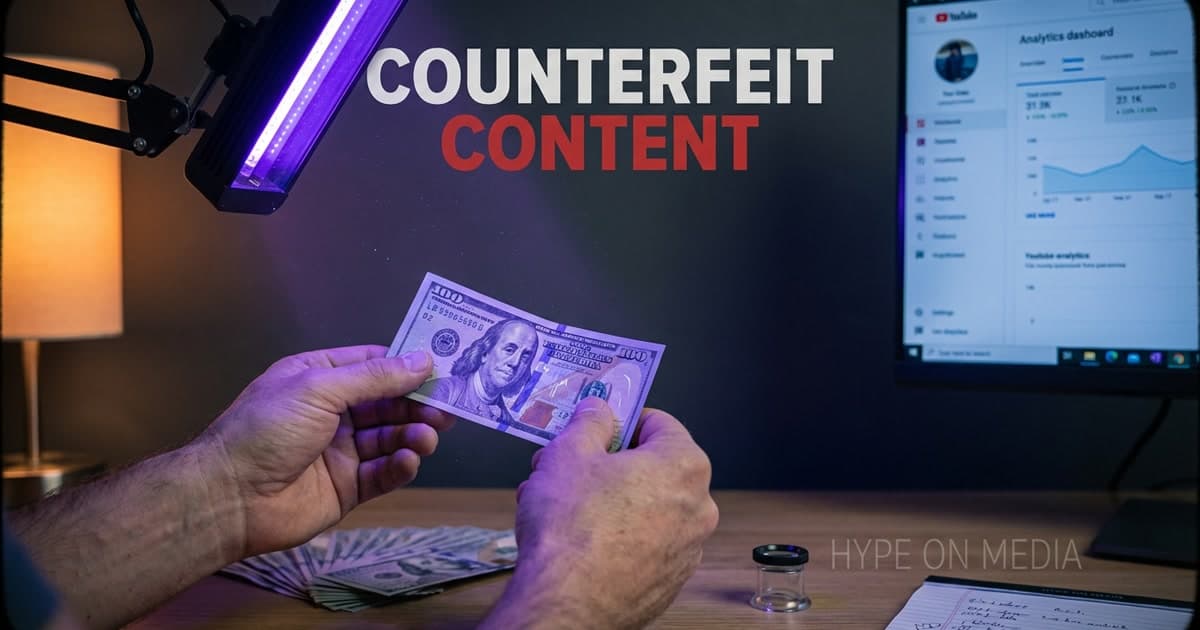
Imagine holding a stack of hundred-dollar bills up to a UV lamp. Under normal light, every bill looks crisp and legitimate. Under ultraviolet, the fakes reveal themselves instantly — no watermark, no security thread, no microprinting. The bills that circulated for years, that fooled cashiers and vending machines, are suddenly and obviously counterfeit.
That is exactly what YouTube did to 2.3 million channels in 2024. The platform's enforcement systems — algorithmic UV lamps running at scale — began scanning every monetized channel for what it calls "inauthentic" content. Videos that looked polished at a distance but lacked the invisible watermark: human creative involvement. The channels that had been collecting ad revenue for years, some generating six figures monthly, suddenly lost everything. Not because the policy was new. Because the scanner finally got powerful enough to catch them.
Think of YouTube's content ecosystem as a currency exchange. Counterfeit content is a bill that passes at the register but fails at the bank — it looks like a real video (thumbnail, title, runtime) but under algorithmic inspection, the security features are missing. No editorial voice. No creative decisions. No human fingerprint. The bill was never real. It just circulated long enough that nobody checked.
This is not a policy change. The prohibition on reused and inauthentic content has lived in YouTube's Terms of Service for years. What changed is the UV lamp: active, algorithmic, retroactive enforcement that does not care how long a counterfeit bill has been in circulation.
What YouTube's Authenticity Test Actually Measures
YouTube's definition of "inauthentic" content is deliberately broad in documentation but surgically precise in enforcement. The official language references "reused content," "repetitive content that provides little or no unique value," and "content that misleads viewers about the source." In practice, the algorithm scores content against five authenticity signals — and failing any two triggers a review.
Signal 1: Creative decision density. The algorithm looks for evidence that a human made meaningful choices — not just that a human pressed "upload." Script structure, editing rhythm, B-roll selection, pacing variation between videos. Channels where every video follows an identical template with zero variation score low. Channels where each video reflects specific editorial decisions — why this angle, why this structure, why this information presented this way — score high.
Signal 2: Voice and identity consistency. Authentic channels have a recognizable personality. A viewer who watches ten videos can identify what makes that channel different from every other channel in the niche. Factory-produced content lacks this coherence — every video could belong to any channel. The algorithm detects this through metadata patterns, engagement signatures, and content fingerprinting.
Signal 3: Source originality. Platform fingerprinting now operates at the file level. Repurposed TikTok content, clip compilations without commentary, automated news narration over stock footage — all of these trigger flags. The threshold for "substantial" transformation is now higher than it was in 2023. Simple re-edits and background music no longer qualify.
Signal 4: Human-in-the-loop evidence. AI-generated content without demonstrable human editorial direction is the fastest-growing category of demonetized channels. This includes AI voice-over compilations, text-to-speech narration of AI-written scripts, and AI-generated slideshow videos. The key word is "demonstrable" — YouTube's systems look for evidence of human decisions, not just human presence in the upload workflow.
Signal 5: Engagement authenticity. Channels flagged under this policy show a characteristic pattern: high view counts with abnormally low comment rates, minimal community interaction, and a subscriber-to-engagement ratio that underperforms category benchmarks by 40% or more. This is the algorithmic UV light at its most revealing — it exposes whether real humans are genuinely engaging or whether the views are passive consumption of interchangeable content.
The Three Profiles That Get Caught
The enforcement does not target ambiguous edge cases. It targets channels built on content arbitrage — acquiring or generating content cheaply and monetizing YouTube's CPM rates without adding the creative value that advertisers are paying for. The counterfeit bills, in other words.
Profile 1: The AI factory operator. Channels that scaled to thousands of videos using fully automated production pipelines. Script generation via LLM, voice via text-to-speech, visuals via stock footage or AI image generation. Some accumulated millions of subscribers before enforcement caught up. The demonetization for these channels is permanent — not a warning, not a probation period. The UV light does not negotiate with counterfeit currency.
Profile 2: The compilation channel without a format. Compilation channels with a defined format, consistent editorial perspective, and evidence of creator involvement have generally survived. Think commentary channels with recurring hosts, or themed compilations with substantial analysis. Channels that compile without adding a consistent creative layer have not. The difference is editorial fingerprint — the same distinction between a curated art collection and a folder of downloaded images.
Profile 3: The outsourced faceless channel at scale. This is where the policy becomes nuanced. Channels that outsource production to professional teams are not inherently at risk. The distinction is creative direction and authenticity. A channel where content reflects genuine strategy, consistent voice, and editorial decisions made by an identifiable team is safe. A channel assembled from a "faceless YouTube automation" course template is not. The watermark is the strategy. If you cannot articulate why each video exists and what creative decisions shaped it, you are holding a counterfeit bill.
What Passes the UV Light
Understanding enforcement requires equal attention to what survives the scan. YouTube has not changed its position on professionally produced content, team-created channels, or channels that use AI tools as part of a human-directed production process.
AI-assisted production is safe. Channels where AI tools assist human creators — AI-aided research, AI-generated thumbnail variants reviewed by a human, AI drafts revised with editorial judgment — are not at risk. The test is not whether AI touched the content. It is whether a human made meaningful creative decisions. A surgeon using a robotic arm is still the surgeon. A robot operating with no surgeon present is a fundamentally different situation.
Agency-produced content is safe. Production agencies managing channels on behalf of brand clients are not flagged, provided the content reflects authentic brand voice and genuine strategy. YouTube evaluates content quality and engagement patterns, not production org charts.
At Hype On, we learned this distinction the hard way in 2019 — long before algorithmic enforcement existed — when a client's outsourced content team produced 47 videos that all scored identically on retention curves. Same pacing, same structure, same editorial flatline. The channel was manually reviewed and flagged. The fix was not cosmetic. It required rebuilding the editorial process from scratch: strategy documents for every video, creative briefs with specific editorial choices, and human review at three stages of production. That channel has maintained uninterrupted monetization through every enforcement cycle since. The content is immune because the watermark is real.
The Four-Question Authenticity Audit
If you are unsure whether your content passes or fails YouTube's authenticity test, this audit takes ten minutes and costs nothing. It might save your revenue.
1. Can you articulate the editorial decisions in each video? If you cannot point to specific creative choices — why this topic, why this structure, why this information presented this way — your content may not demonstrate sufficient creative value. The bar is not impossibly high. It requires that a human made real decisions and those decisions are traceable.
2. Does your channel have a consistent, recognizable voice? Authentic channels are distinguishable. A viewer who watches ten of your videos should identify what makes your channel different from every other channel covering the same topics. Factory content lacks this coherence. If your content is interchangeable, it is vulnerable.
3. How much depends on other creators' material? If more than 30% of your video frames originate from content you did not create, you are in compilation territory. If that compilation lacks consistent, substantial commentary, you are in the risk zone.
4. What does your engagement signature look like? Channels with high views but comment rates below 0.5%, subscriber-to-engagement ratios that trail category benchmarks, and flat retention curves are algorithmically flagged before any human reviewer gets involved. The engagement signature is the first UV wavelength — it reveals whether real humans are genuinely watching or whether the views are passive consumption of content that could belong to anyone.
The Enforcement Escalation: Where This Goes Next
We predicted at the start of 2024 that enforcement would accelerate — and the data proved it. YouTube removed monetization from 2.3 million channels in 2024, a 340% increase from the previous year. By July 2025, the platform escalated further: repeat violations now result in full channel termination, not just monetization suspension. The appeals success rate for inauthentic content violations dropped to under 8%.
The trajectory is unmistakable. YouTube is building toward a platform where the economic model rewards content that is genuinely valuable to viewers. Channels built on content arbitrage — the counterfeit bills — are an inefficiency in that model, and the enforcement infrastructure is systematically eliminating them. Every enforcement cycle increases the UV lamp's sensitivity. Bills that passed inspection last year get caught this year. Bills that pass today will get caught in 2026.
The channels that survive long-term are the ones where content quality, creative authenticity, and audience value are not compliance strategies — they are the actual product. Whether you build that in-house or work with a team that specializes in it, the framework is the same: every video needs a traceable creative decision chain, a consistent editorial voice, and genuine engagement signals. The bills with real watermarks never worry about the UV light, no matter how powerful it gets.
Frequently Asked Questions
What does YouTube consider "inauthentic content"?
YouTube's inauthentic content policy targets videos that lack clear creative value — including fully AI-generated content without human editorial direction, clip compilations without substantial commentary, mass-produced faceless channels following factory templates, repurposed content from other platforms, and automated news narration channels. The policy has existed for years; what changed in 2024 is active enforcement with algorithmic detection that scanned 2.3 million channels and a dramatically harder appeals process.
Can channels using AI tools still qualify for monetization?
Yes. YouTube's policy does not prohibit AI tool usage — it targets content that lacks demonstrable human creative involvement. Channels where AI assists human creators (AI-aided research, scripted drafts revised by humans, AI-generated thumbnail options selected by a creative director) are not at risk. The test is creative direction, not tool usage. The watermark is the human decision, not the absence of AI.
How does YouTube's algorithmic detection actually work?
YouTube's enforcement uses a multi-signal scoring system that evaluates creative decision density, voice consistency across videos, source originality at the file level, human-in-the-loop evidence, and engagement authenticity patterns. Channels that fail on two or more signals simultaneously are flagged for review. The system processes channels continuously — not in batches — meaning new violations are caught within weeks, not months.
What happens if my channel is flagged for inauthentic content?
You receive a monetization warning with a 30-day remediation window. If violations persist, monetization access is suspended. The appeals process for this violation category is significantly harder than for other YPP infractions — the approval rate is under 8%, and successful appeals require demonstrating substantive content changes, not just explanations of existing content. Under the July 2025 update, repeat violations can result in permanent channel termination.
Are production agencies at risk under the new enforcement?
No, provided the content reflects genuine strategy and creative direction. YouTube distinguishes between channels produced by professional teams with traceable editorial processes and channels manufactured by automated systems or course templates. The test is editorial authenticity and content quality, not production structure. The watermark that matters is the creative decision chain — from strategy through scripting through final review.