The Whole Factory, Not Just the Bad Batch
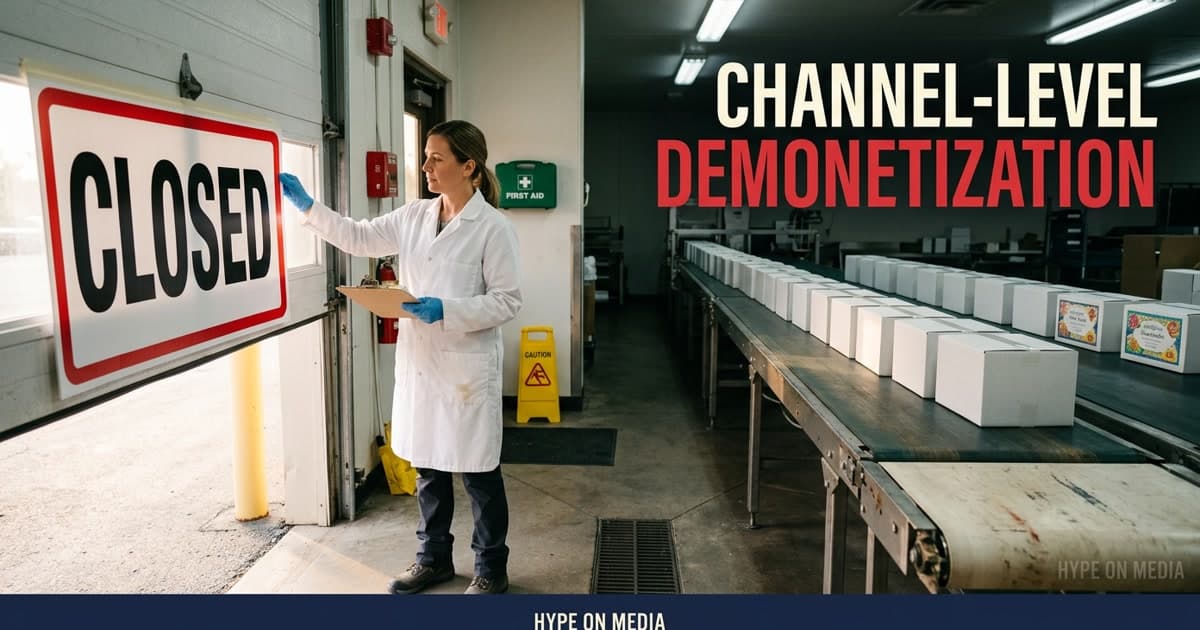
A food safety inspector does not test one jar of peanut butter and call it done. She inspects the factory. If 70% of the production line is contaminated — even if a few jars are perfect — she shuts down the whole operation. She does not demonetize individual jars. She closes the factory.
That is exactly what YouTube did on July 15, 2025. The platform shifted its "original and authentic" enforcement from individual videos to channels as a whole. Previously, a channel could maintain monetization by ensuring most content passed video-level review, even if a portion was borderline. Now, YouTube inspects the factory floor. If the content pattern across your library does not meet the standard, the entire channel loses monetization — regardless of how many individual videos pass in isolation.
This was not widely publicized in advance. For thousands of channels operating in the monetization grey zone — compilation-heavy channels, minimal-commentary reaction content, voiceover-over-stock-footage operations, AI content farms — it was immediately consequential. The factory got shut down.
What "Original and Authentic" Requires Now
YouTube's updated language specifies that monetizable content must demonstrate "clear added value" beyond source material. Several content patterns now fail this standard explicitly.
Minimal transformation reuse — taking existing video and making only minor edits (speed changes, filters, watermark removal, basic cuts) without adding commentary or new creative expression — is a channel-level disqualifier. Content that is another creator's work with surface modifications does not pass.
Automated synthesis content — videos composed primarily of AI text-to-speech over stock footage, AI-assembled B-roll montages, or AI avatar presentations of unattributed scripts — requires explicit disclosure and content that substantially extends beyond what an AI pipeline could produce without human creative direction.
Passive aggregation without curation value — compilations assembling third-party clips without meaningful editorial framing, thematic analysis, or authorial perspective. YouTube's line: a compilation that would exist identically if anyone assembled the same source clips fails the value standard. A compilation with distinctive selection and editorial commentary can pass — but the value must be evident in the content, not claimed in the description.
Reaction content below the commentary threshold — watching and minimally reacting to third-party content without substantive commentary. YouTube references "substantive discussion or commentary" as the threshold. Laughing at clips or briefly affirming content does not clear this bar.
Why Channel-Level Enforcement Changes Everything
The shift from video-level to channel-level enforcement is the structural change that matters.
Previously, enforcement economics favored creators: individual video reviews were relatively easy to pass, and a channel with 80% compliant content and 20% borderline had limited risk. The inspector checked the jars, not the factory.
Channel-level enforcement inverts this. YouTube now evaluates the content pattern across the library. A channel where 30% passes the authenticity standard and 70% represents aggregated content can face full monetization removal — even if each individual video in the compliant 30% would pass video-level review alone.
The practical implication: channels with large libraries of borderline content cannot simply produce new compliant videos going forward. The historical library creates ongoing risk. Affected channels face a real decision: content cleanup (removing non-compliant videos), channel migration (starting fresh), or appealing for review.
What Passes the Factory Inspection
Understanding what YouTube protects — not just penalizes — is the faster path to compliance.
Original performance, demonstration, and expertise content is the clearest safe category. A creator demonstrating a skill, sharing expertise, reviewing a product from firsthand experience, or performing original creative work produces content that could not exist without that specific creator's contribution.
Transformative critical analysis passes when the analysis substantively alters how a viewer understands source material. A film essay using clips to support a critical argument about narrative structure is transformative. A video playing significant clips with minimal interjection is not.
Clearly disclosed AI-assisted content with human creative direction is not prohibited. YouTube's policy requires that creative direction, selection, framing, and value be attributable to a human creator. A creator using AI for scriptwriting assistance while maintaining editorial control is not at risk.
Educational and informational content with genuine expertise — tutorials, how-to guides, educational explainers, news analysis with original reporting — passes consistently. The value is in the creator's knowledge, not in aggregation of others' content.
How This Affects Compliant Channels (Positively)
For channels producing original content at a professional standard — strategy-driven, expertly scripted, professionally produced — the July 2025 change represents zero risk and significant opportunity.
Hype On has never produced content that would fail an authenticity check. Every video across our client portfolio is original, strategically scripted, and produced with genuine creative intention. Our clients do not worry about policy changes because their content is genuinely valuable.
The opportunity: the enforcement removed a significant share of low-quality inventory from YouTube's monetizable pool. With fewer channels competing for ad revenue, CPMs for qualifying channels improved. Several clients saw 8-15% CPM increases in Q3 2025 compared to Q3 2024 — a direct effect of reduced competition from low-quality content.
The strategic implication: invest in content differentiation, not volume. The policy now penalizes high-frequency, low-quality production. Original, high-value content published less frequently but with strategic intent outperforms volume-based approaches in both compliance stability and audience development.
The Compliance Audit Framework
If you manage a channel with significant historical content, this audit identifies exposure.
Quantify your reuse percentage. What share of your library is primarily composed of third-party video? If this exceeds 20-25%, the channel has measurable risk. A channel with 1,000 videos and 50 borderline pieces is at different risk than one with 200 videos and 50 borderline pieces.
Review against the value standard. For each borderline piece: does this video create value that would not exist without this creator's specific contribution? If anyone with access to the same source clips could produce it identically, it does not pass.
Check AI disclosure practices. YouTube recommends explicit disclosure in descriptions and, for heavily AI-generated content, in the video itself. The policy direction indicates disclosure will become increasingly important.
Document original production evidence. Raw footage, script drafts, production notes, team communications — this provides the factual foundation for appeals if your channel faces review.
Prioritize cleanup over new production. If the audit reveals significant non-compliant content, systematic removal reduces channel-level risk more efficiently than adding compliant content to a contaminated library.
Frequently Asked Questions
What exactly changed in YouTube's July 2025 authenticity policy? YouTube shifted enforcement from individual video review to channel-level pattern assessment starting July 15, 2025. Channels whose content library demonstrates systematic use of non-original content can face full channel monetization removal — even if individual videos pass video-level review.
Which content types are most at risk? The highest-risk types are: minimal-transformation reuse compilations, reaction content with minimal commentary, voiceover-over-stock-footage channels without demonstrated expertise, and AI-generated content assembled without clear human creative direction.
How does YouTube detect AI-generated content? YouTube uses metadata patterns, audio signature analysis, visual similarity to known AI assets, production pattern recognition, and cross-channel similarity analysis. Detection is not perfect but improving rapidly, with significant ongoing investment.
What happens if your channel gets flagged? Channels flagged receive a YouTube Studio notification with a 30-day window to appeal or address issues. During this window, monetization may be suspended. Successful appeals require demonstrating that flagged content meets the added value standard or removing it from the library.
Does the policy affect CPMs for compliant channels? Yes — positively. Reduced low-quality inventory means reduced ad supply with stable demand. Compliant channels in competitive categories reported 8-20% CPM increases in Q3 2025 compared to Q3 2024.