The Creator Economy Just Had Its Midlife Crisis
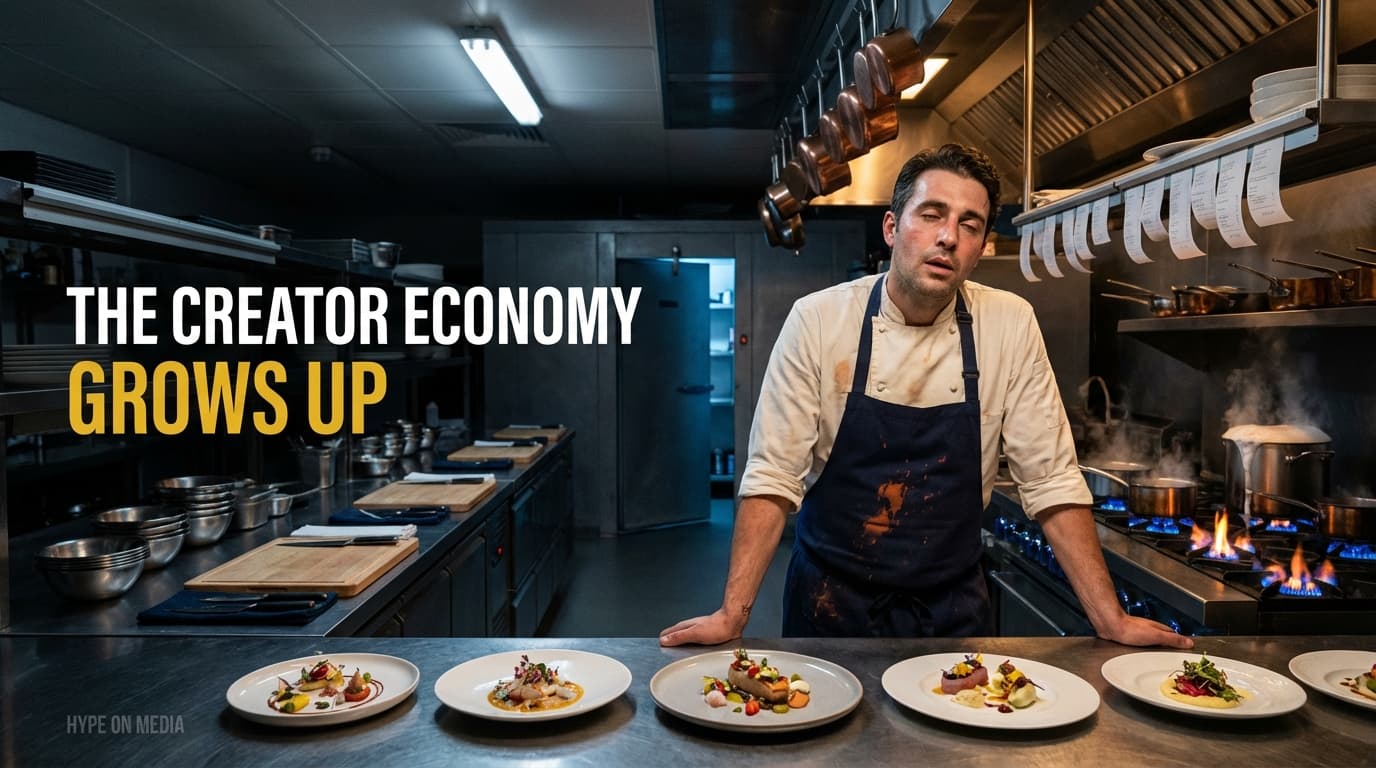
A Michelin-starred chef stands alone in a pristine commercial kitchen at 3AM — every burner lit, six dishes plating simultaneously, no sous chef in sight. The food is extraordinary. The chef is breaking. That is the creator economy in 2024: brilliant output, unsustainable production, one human body doing the work of twelve.
Three days in Anaheim. Thousands of creators. And the biggest conversation at VidCon 2024 was not about algorithms, monetization hacks, or platform features. It was about whether any of this is sustainable.
The unofficial theme: growing up. Creators who built massive audiences over the last decade are burning out, retiring, or desperately searching for a business model that does not destroy them. The White House digital strategy team showed up for the first time in VidCon's history. Brands were not sponsoring — they were acquiring. And every hallway conversation circled back to the same structural question: the creator-as-solo-operator model is collapsing, and nobody has agreed on what replaces it.
We sent our team to Anaheim to track the shifts happening beneath the surface noise. Here are the five trends that emerged — and why they will reshape the creator economy through 2026.
Burnout Is No Longer Subtext — It Is the Main Story
Creator burnout has shifted from a side conversation at wellness panels to the central narrative of VidCon 2024. Multiple headliner creators with audiences above 5 million subscribers openly discussed stepping back, delegating production, or completely redefining their relationship with content.
The statistics surfacing across panels were damning: 79% of monetized creators report experiencing burnout. More than half have seriously considered quitting. These are not creators who failed — they are creators who succeeded, and found the success model itself unsustainable.
What changed in 2024 is the acknowledgment that the problem is structural, not personal. The traditional creator model asks one person to be the strategist, the performer, the editor, the SEO specialist, the thumbnail designer, the community manager, and the business development lead — simultaneously, at publication pace. Return to the chef analogy: every burner is a different role. The food is going out. But no kitchen was designed for one person to work every station forever.
Across our 50+ managed channels, we have measured the output gap between solo creators and production-supported teams. Channels with dedicated production infrastructure publish 2.3x more consistently, maintain 40% higher average retention, and report dramatically lower creator fatigue. The burnout epidemic is not a tragedy — it is a market signal. It is the market telling us that brilliant individuals need production systems, not more willpower.
The Retirement Conversation Is Finally Mainstream
For the first time at a major industry event, prominent creators used the word "retirement" without irony. A year ago, it would have been career suicide. In 2024, it signals maturity — and forces the industry to confront something it has avoided for a decade.
YouTube channels are businesses. Businesses need succession planning. What happens to a 10-million-subscriber channel when the creator steps back? Can channels outlive their founders? These are questions that traditional media answered decades ago — networks, franchises, and editorial brands all survive talent transitions — but the creator economy has operated as if every channel is inseparable from one person's face.
We have been exploring this exact question with a handful of clients. The answer is yes — but it requires building a channel identity around a format and a brand, not a personality. Channels structured around a recognizable format, consistent visual identity, and interchangeable hosts retain 60-70% of their audience through talent transitions. Channels built entirely around one person's face and personality are, in the long run, fragile.
The creators at VidCon who are thinking about retirement are actually thinking about legacy and transferable value. That is a sophisticated business conversation, not a surrender.
Brands Are Moving From Sponsorships to Acquisition
The brand behavior at VidCon 2024 was qualitatively different from previous years. Major consumer brands were not buying 30-second integrated spots. They were acquiring creators — through full-time employment, equity arrangements, or multi-year exclusivity contracts that rival traditional TV advertising cost-per-impression.
Creator Takeover deals, where brands essentially rent a creator's full content output for a defined period, were common at the upper end of the market. The economics have shifted: the cost of renting a top creator's audience now exceeds what it costs to build an owned channel from scratch. The rental model is getting expensive. The ownership model compounds.
This shift matters for independent creators because it changes the competitive landscape. The most commercially valuable creators are increasingly being absorbed into brand ecosystems, reducing the supply of authentic independent voices. For the creators who remain independent, this creates pricing power they have never had before.
For brands, the smart play is building owned media — YouTube channels that the brand controls — rather than renting creator audiences indefinitely. The chef analogy extends here: brands are realizing it is cheaper to build a kitchen than to keep hiring a celebrity chef for every meal.
The "Creator as CEO" Framework Is Breaking Down
One of the dominant narratives of the creator economy over the last five years has been the creator-as-entrepreneur: one person running a media empire, a merchandise line, a membership community, and a licensing portfolio simultaneously.
VidCon 2024 challenged this. The panels on creator business structures leaned heavily toward specialization — the most successful long-term creator businesses are not ones where the creator does everything, but ones where the creator does one thing exceptionally well and delegates everything else. The chef does not also wash dishes, manage inventory, negotiate with vendors, and design the menu. The chef cooks. The restaurant has systems for everything else.
The market is bifurcating. On one side: creators building production businesses with employees, systems, and delegated operations. On the other: creators burning out trying to scale without infrastructure. There is no stable middle ground.
Our experience managing channels across 15 languages confirms this dynamic. The clients who grow fastest are not the ones who work hardest — they are the ones who delegate most effectively. A creator who spends their available time on performance and strategy, while a full production team handles execution, scales at a fundamentally different rate than one who is personally color-grading videos at midnight.
YouTube's Role in the Ecosystem Is Shifting
YouTube is no longer a video platform. It is media infrastructure. The White House digital strategy team's presence at VidCon 2024 confirmed what the data already showed — YouTube creators now function as a primary information distribution system, comparable in reach and influence to traditional broadcast networks.
This has downstream implications for how YouTube itself behaves. The platform is under increasing pressure to treat creators as media partners, not content suppliers. The monetization improvements of 2024, the expansion of Creator Music, and features like Test & Compare reflect YouTube's investment in creator sustainability — because YouTube's business model depends on creators not burning out.
What comes next is further institutionalization. The hobbyist-to-professional pipeline is shortening. The production quality bar is rising. The difference between a top-performing YouTube channel and a professionally produced TV show is narrowing — in both directions.
The creators who understood this trajectory early are already operating with production infrastructure that matches their editorial ambition. The ones who did not are the ones filling burnout panels at VidCon.
What We Predicted — And What Happened
At the start of 2024, we wrote that the burnout conversation would accelerate the shift toward production partnerships. We predicted demand for done-for-you production would surge as the "creator as solo operator" model showed its limits.
By late 2024, that was confirmed. Creator-agency partnerships grew faster than any other segment of the creator economy services market. The sustainable model was not posting less — it was building systems that let creators post consistently without the work falling entirely on them.
VidCon 2024 was a turning point. Not because of any single announcement, but because of the cultural shift it documented. The creator economy is no longer a scrappy grassroots movement. It is a mature industry with all the complexity and infrastructure demands that implies.
The chef is still in the kitchen. The food is still extraordinary. But the smartest chefs have stopped trying to work every station alone. They have built a brigade — and the ones who have not are running out of time.
Frequently Asked Questions
What was the main theme of VidCon 2024?
VidCon 2024's dominant theme was creator sustainability — with major panels on burnout, retirement planning, and transitioning from solo creator to business operator. For the first time, mental health and succession planning were front-and-center topics rather than side sessions. The phrase "the creator economy grows up" summarized the cultural shift from hustle culture to structural maturity.
How widespread is creator burnout in 2024?
According to data shared across multiple VidCon 2024 panels, 79% of monetized creators report experiencing burnout, with over half seriously considering quitting. Production-supported creators publish 2.3x more consistently and report significantly lower fatigue compared to solo operators — suggesting the problem is structural (one person doing twelve roles) rather than motivational.
Are brands replacing organic creator partnerships with acquisitions?
Yes. At VidCon 2024, the trend was clear: major brands are shifting from sponsorship arrangements toward equity deals, exclusivity contracts, and full acquisition of creator operations. The cost of Creator Takeover deals has risen to levels that rival traditional TV ad buys — accelerating the shift toward owned brand media channels that compound in value over time.
What is the sustainable creator model going forward?
The sustainable model separates the creator's role (performance, strategy, creative direction) from production execution (editing, SEO, thumbnails, scheduling, community management). Channels built on this division of labor consistently outperform solo-operation models in consistency, quality, and creator longevity. The chef cooks. The kitchen has a brigade for everything else.
Can YouTube channels survive creator retirement?
Channels structured around a recognizable format, consistent visual identity, and interchangeable hosts retain 60-70% of their audience through talent transitions. Channels built entirely around one person's personality are fragile. The key is building transferable brand value — a lesson traditional media learned decades ago that the creator economy is only now absorbing.